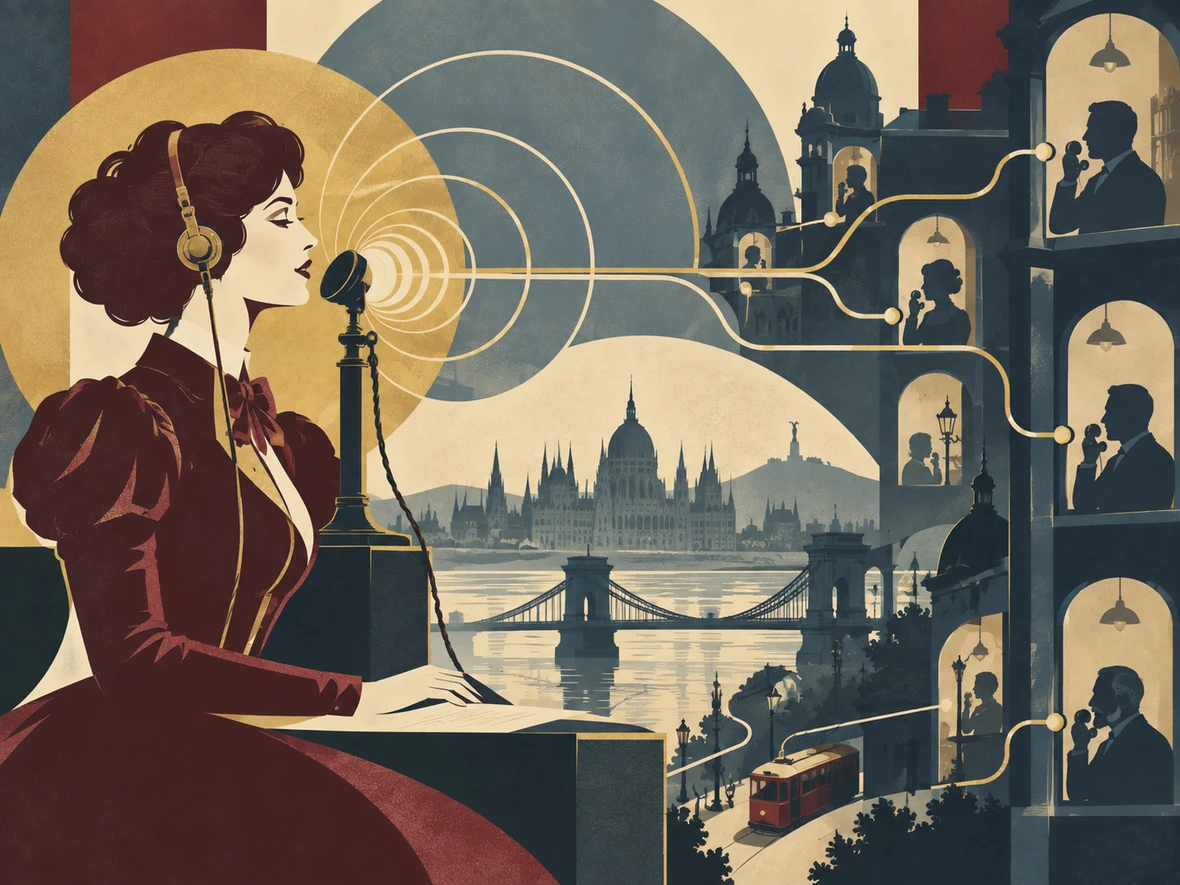
On 15 February 1893, Budapest started publishing a newspaper that could not be folded, dropped in a puddle or used to wrap anything.
The Telefon Hírmondó had reporters, editors, schedules, subscribers and breaking news. What it did not routinely deliver was a printed edition. News was gathered in a central office, edited into copy and read aloud into telephone transmitters so that subscribers around the city could listen through receivers. A contemporary American notice described the arrangement within weeks of its launch: one newsroom, many listeners, and spoken updates distributed over wires.1
This was more than a clever use of the telephone. It was a media organization built around the problem of publishing without a page.
Tivadar Puskás, the Hungarian telephone engineer behind the service, launched it while the ordinary urban telephone was still expensive and closely associated with businesses, government offices, hotels and other institutional users. The Hungarian National Archives dates the public opening to 15 February 1893 and notes that existing telephone subscribers could initially ask to be connected; a separate network for the Hírmondó followed.2 Puskás died on 16 March, only about a month after the opening, so almost all of the service’s long institutional life belonged to successors who had to turn his new system into something customers would keep paying for.7

By 1901, visiting writers were no longer describing a laboratory curiosity. Thomas S. Denison reported about 6,200 subscribers and a staff that included a business manager, an editor-in-chief, four assistant editors and nine reporters. Another contemporary account put the audience above 7,000. The numbers vary with date and source, but the organizational point is hard to miss: Budapest had a newsroom producing a daily audio service at commercial scale.3,4
Its schedule looked like somebody had taken the sections of a newspaper and stretched them across a clock.
Political reports, stock and exchange quotations, court news, local and foreign items, theatre criticism, markets and weather appeared at set times. Summaries served people who had missed an earlier report. Concerts and theatrical performances occupied later slots. Contemporary writers called the strong-voiced readers “stentors,” which was both a job title and a warning that nineteenth-century audio engineering expected the human throat to contribute generously.3,4
The distribution technology was unusual, while the editorial workflow remained strikingly familiar. Denison described reporters writing out their assignments and submitting them to an editor, who approved the copy. The material was then reproduced inside the office, checked, preserved as a file and cut into reading strips for the stentors. The same account says the editor bore responsibility in libel actions and had already dealt with lawsuits.3 A medium whose words vanished into listeners’ ears therefore generated a surprisingly physical paper trail behind the scenes.
That paperwork solved a problem the printed newspaper barely had to notice. If someone challenged a printed story, the publisher could point to the edition. Spoken publication disappeared at the moment of delivery. Telefon Hírmondó needed an internal answer to a very practical question: what exactly did we say at that hour, and who approved it?
The solution was to preserve the newsroom even while removing paper from the subscriber’s end of the transaction.
Calling the service “radio before radio” captures one resemblance and conceals several others. The comparison is understandable. One source sent common programming to many listeners; the audience received news and entertainment without speaking back; eventually the service carried concerts, opera and theatre. Hungarian archival histories explicitly describe it as a direct predecessor of radio in Hungary.2 But calling it early radio can hide the part that contemporaries themselves found important: they repeatedly described it as a newspaper.
Telefon Hírmondó behaved like one. It bought telegrams at press rates, exchanged courtesies with the printed press, employed reporters and editors, maintained a daily file and sold subscriptions. Denison found it had no leading editorials in the ordinary printed sense, but its legal and organizational life remained journalistic enough that defamation law did not evaporate just because the ink had.3
The network also changed what a subscriber was subscribing to. Ordinary telephony was organized around one party calling another. The Hírmondó’s job was the opposite: one source had to reach large numbers of receivers simultaneously. The Hungarian National Archives records the move from early connection through the telephone system to purpose-built Hírmondó wiring, and later descriptions show wall-mounted listening sets without a speaking component.2,5 The listener was not calling the newsroom. The newsroom had an appointment with the listener.

Because there was no page to scan, timing took over part of the job normally performed by layout.
A printed reader can jump from foreign news to markets and then to theatre notices by moving across a sheet. A Hírmondó subscriber had to know when those things were scheduled. Denison’s 1901 programme assigned different kinds of material to different periods and repeated brief summaries later in the day.3 The system turned chronology into navigation: the programme guide was effectively an index whose page numbers were clock times.
That arrangement also makes subscriber totals slightly deceptive. Contemporary accounts mention hotels and other shared establishments among the connected customers.3 A single subscription could put several people near the receivers. The company was counting connection points; ears remained stubbornly difficult to invoice one at a time.
The subscription itself also looked more like infrastructure than buying a paper at a kiosk. Denison described receivers installed in the subscriber’s premises at the company’s expense and a payment arrangement that effectively committed the customer for a year.3 An aggrieved reader of a printed newspaper could stop purchasing tomorrow’s copy. A Hírmondó customer first had to reckon with equipment already fixed to the wall. The future of media had discovered the service contract rather early.
By the first decade of the twentieth century, the service had survived long enough to become infrastructure. Scientific American was still discussing it in 1907, fourteen years after launch.6 Longevity matters here because nineteenth-century electrical history is full of demonstrations that dazzled an audience and then went home with the inventor. Telefon Hírmondó had to maintain lines, pay staff, fill hours of programming and survive the much less glamorous experiment of whether subscribers renewed.
Its later relationship with radio was not a clean technological execution. Regular Hungarian radio broadcasting began in 1925, and the Hungarian National Digital Archive notes that Budapest radio and the wired service carried the same programme from the start of radio operations. The Hírmondó network survived into the Second World War, when the system was destroyed.5 The old medium and the new one overlapped because working infrastructure rarely agrees to disappear merely to make a technology timeline easier to draw.
What became obsolete was the need to run dedicated audio wires to make common programming feel normal. By the 1920s, wireless broadcasting was turning “one voice, many homes” into an expected media form. Telefon Hírmondó had already spent decades discovering the editorial and commercial routines that such a form required.
The service consequently resists tidy labels. It was not simply a giant telephone call, because subscribers did not ring one another and the content followed a common schedule. It was not a printed newspaper, though reporters and editors worked in recognizable newspaper routines. It anticipated broadcasting without using the wireless technology that later defined radio.
The most revealing surviving descriptions are therefore full of ordinary office details. Reporters filed copy. Editors approved it. Proofreading happened. Lawsuits happened. Customers complained. Schedules were published. Performers were booked. The radical technology was being kept alive by administrative work so familiar that nobody thought it needed a futuristic name.
Budapest had removed the page from the newspaper and discovered that nearly everything else still needed doing.