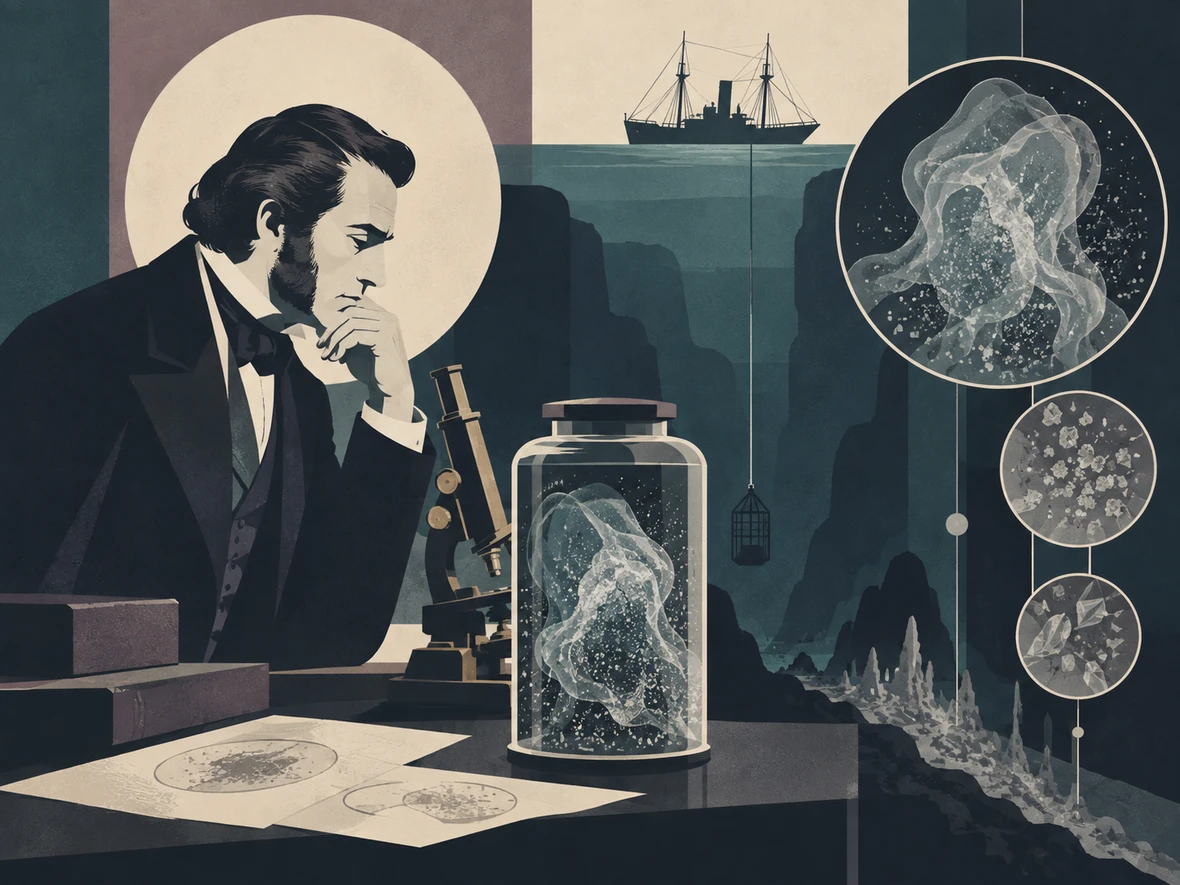
In 1868, Thomas Henry Huxley gave a scientific name to something that had been sitting in a bottle since 1857.
The bottle contained mud from the floor of the North Atlantic. HMS Cyclops had collected it while sounding the route proposed for the transatlantic telegraph cable, and Huxley had examined some of the material soon afterward. He found real microscopic structures in it, including the calcareous bodies he called coccoliths. A decade later, looking again at preserved deep-sea material, he noticed something else: transparent gelatinous matter spread through the sediment and behaving under the microscope rather more like protoplasm than a mineral had any business doing.1
He named the supposed organism Bathybius haeckelii, after the German biologist Ernst Haeckel. In October he wrote to Haeckel about the new “Moner” and hoped his colleague would not be ashamed of his “god-child.”2
The chronology of the bottle is important. Huxley’s first report on the Cyclops mud, published in 1858, discussed the microscopic calcareous bodies he called coccoliths but did not introduce Bathybius. His 1868 paper explicitly returned to those earlier soundings and described the gelatinous material as a new observation.1 The specimen had therefore spent years in storage between the original examination and the interpretation that made it famous—exactly the interval in which the preservation method matters most.
The god-child had one awkward qualification: nobody had seen it alive. That was not initially disqualifying. Deep-sea biology in the 1860s depended heavily on bringing material to the surface, preserving it, sending it elsewhere and asking microscopes to recover a world that the observer had never watched in place. The Atlantic cable surveys had unexpectedly supplied naturalists with samples from depths that had previously been much easier to discuss than to inspect. Huxley was working with genuine deep-sea mud containing genuine microscopic life and mineral structures. The suspect material was mixed into a specimen that had every reason to be interesting.1
His 1868 description was also more cautious than the legend that grew around it. Huxley did not announce that he had personally discovered the universal ancestor of every organism on Earth. He compared the gelatinous substance with very simple forms of life then being discussed by Haeckel and proposed that it belonged among them. Later polemical accounts inflated that into a much grander declaration, to the annoyance of writers who went back and actually read the paper.1,6
Haeckel supplied more of the theoretical enthusiasm. His work on “Monera” concerned organisms of extremely simple organization, and Bathybius seemed wonderfully cooperative: a widespread, formless living substance on the deep ocean floor looked like unusually accessible material for arguments about primitive life.3 It was an attractive fit between specimen and theory, which is not the same thing as a conspiracy. Sometimes evidence arrives looking exactly like the thing a researcher has been hoping exists. This is generally when the evidence deserves a second appointment.

The awkward question was what the material had looked like before preservation. Huxley could describe what was in the bottle. He could stain it, compare its texture with known organic substances and examine the real coccoliths embedded in the same ooze. What the bottle could not provide was a control sample from the ocean floor that had never met strong alcohol. The collection method had placed an invisible event between the sea and the microscope.
HMS Challenger made that gap harder to ignore. Beginning in 1872, the expedition sampled widely across the world’s oceans with a scientific staff able to examine fresh material aboard ship. If Bathybius really formed a widespread component of deep-sea ooze, this was a very expensive and unusually well-equipped opportunity for it to turn up before anyone preserved anything.4
The expected organism did not cooperate. By 1875, Wyville Thomson could tell Huxley that the Challenger staff had repeatedly failed to find Bathybius in a fresh state. More damagingly, they had a chemical explanation for the old bottles. Strong alcohol added to seawater could precipitate calcium sulfate in a flocculent, gelatinous-looking form. The supposed protoplasm was therefore capable of appearing during preservation. Huxley published the report in Nature and noted that the inorganic precipitate could look remarkably like organic material and could even take up carmine stain in a persuasive way.4
The preservative had not merely failed to preserve one feature accurately. It had manufactured the feature.
That distinction is what makes the episode better than a generic story about a Victorian scientist being wrong. A specimen jar is often treated as a transparent bridge between field and laboratory: collect the object, stabilize it, transport it, then study what was there. Chemically, the jar has never signed that contract. The fluid joins the sample as another reagent. In this case, the substance intended to stop change produced a new material convincing enough to be classified as life.
Huxley’s private reaction was unusually helpful to anyone hoping for a villain. He refused to provide one.
Writing to physiologist Michael Foster in August 1875, he reported that the Challenger people thought Bathybius might be a mineral precipitate and immediately predicted the obvious joke: an enemy would call it a product of his own “precipitation.” He claimed the joke first and added that, if there were a leek to eat, he would eat it handsomely.5 In the public Nature note he was equally direct. Because he was chiefly responsible for introducing the substance into the list of living things, he said, he intended to give the contrary explanation even more weight than Thomson was yet willing to give it.4
There was no ceremonial instant in which every scientist closed the file. Thomson himself remained guarded in 1875, and Haeckel was still arguing in 1877 that the broader Monera question should not be buried with one disputed substance.3 Scientific claims usually acquire cleaner death certificates in later summaries than they possess while people are actually deciding what the evidence means.
The Darwinism angle became cleaner too, mostly by becoming less accurate. Opponents of evolution quickly treated Bathybius as though it had been a foundational support for natural selection and its disappearance therefore removed a load-bearing wall. Haeckel complained about precisely that argument in 1877. Huxley later made the same distinction from the other direction: whether one proposed elementary organism existed had no serious bearing on Darwin’s general theory.3,6
The correction changes who deserves the sarcasm. Huxley made a real observational and interpretive mistake. That mistake does not need to be upgraded into an imaginary manifesto before it becomes interesting. A bottle of cable-survey mud had already produced a named organism that existed because the preservative met seawater. The historical material is doing enough work.
Most of the oceanography survived the correction perfectly well. Deep-sea life was real. Coccoliths were real. The Challenger expedition returned an enormous body of genuine zoological, chemical and physical observations. The error was narrower, which made it more instructive: one particular gelatinous substance in preserved mud had been assigned to the biological world when its relevant history began after collection.1,4
The coccoliths make the case especially instructive because Huxley had not imagined every microscopic feature in the jar. Some structures were genuine components of the sediment; the gelatinous matrix around them was the misleading part. A specimen can therefore contain genuine observations alongside an artifact. The correction required separating them rather than discarding the entire sample as worthless.
That problem has not become antique. Modern laboratories still have to distinguish the thing being studied from changes introduced by fixation, storage, staining, extraction, amplification, imaging and measurement. The techniques are different; the underlying question is familiar. Did the apparatus reveal the phenomenon, or did the procedure help create it?
In Bathybius, the answer was unusually literal. The 1857 expedition collected mud because engineers wanted to know what lay beneath a future telegraph cable. The sample reached Huxley, sat preserved, and later seemed to contain a form of primitive life. A much larger oceanographic expedition then went looking for the same material before preservation and instead found an explanation in the preservative itself.
The ocean had not hidden Bathybius from the Challenger. The bottle had been the only habitat it ever had.