The American postal system developed an office whose job depended on a rather awkward exception to postal privacy: sometimes the only way to deliver a letter was to open it.
The problem appeared early. In October 1777, during the Revolution, Congress authorized an “Inspector of Dead Letters,” with the duties assigned to postal surveyor Ebenezer Hazard.1 The title sounds like something invented after a century of bureaucracy. The bureaucracy was two years old.
Federal law soon made the procedure more explicit. The Post Office Act of 1792 required local postmasters to publish lists of unclaimed letters. After another waiting period, letters still unclaimed were to be sent to the General Post Office, where they could be opened and inspected for valuable papers or other consequential material.2 Congress repeated a similar system in the postal law of 1825.3 So 1825 matters, but not because Americans had spent the previous fifty years staring helplessly at undeliverable envelopes.
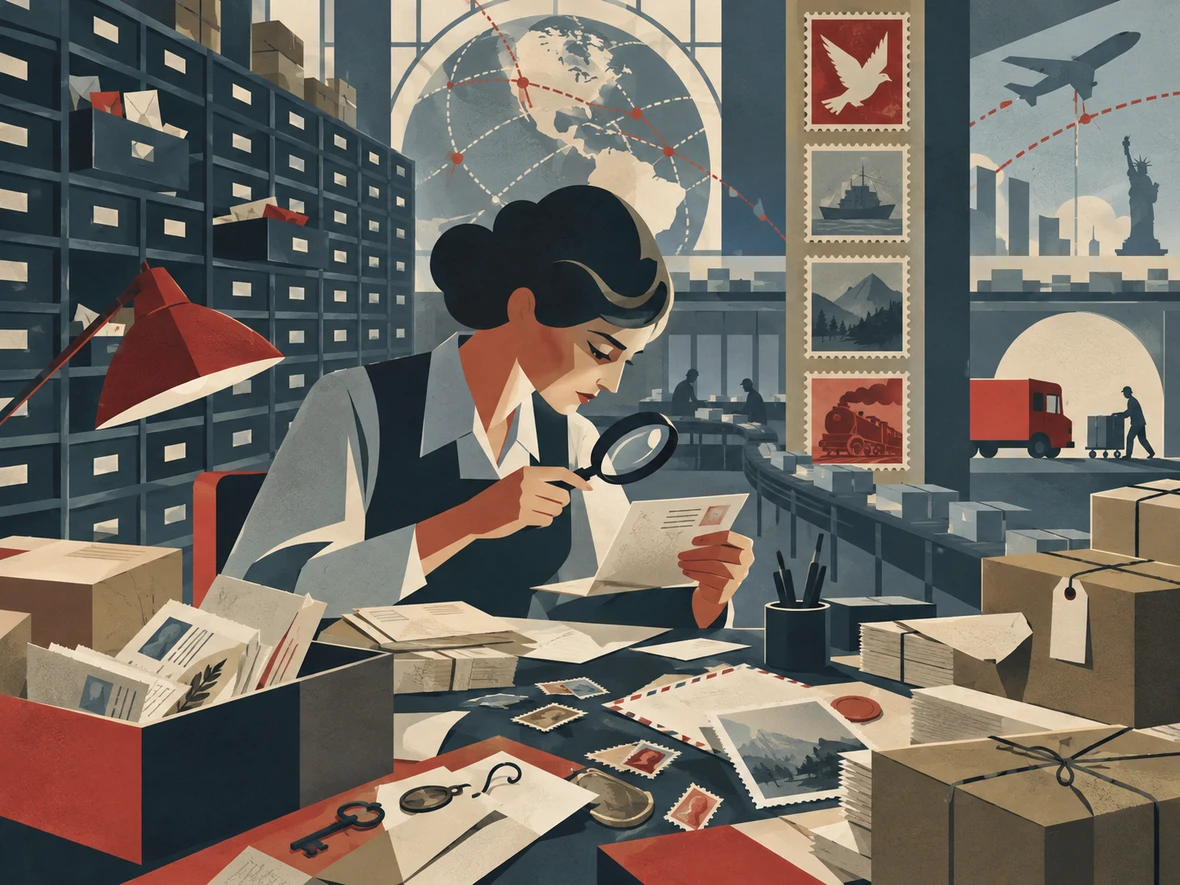
As the nineteenth century progressed, the Dead Letter Office became a specialized routing operation for mail that ordinary routing had failed. Clerks first worked from the outside: handwriting, place names, postal markings, scraps of geography and whatever else the envelope offered. Opening the item was a last resort.
Smithsonian postal historians note that only Dead Letter Office clerks had authority to open this mail, and regulations limited them to reading the minimum needed to identify the sender or intended recipient.4

That turned privacy into a job description. A clerk might have permission to open a stranger’s letter while simultaneously being forbidden to read the interesting part.
The work demanded more than penmanship. Clerks used knowledge of languages and geography, along with reference books containing street names and other location information.4 Particularly difficult addresses became known as “blind readings.” The phrase was less insulting than descriptive: to an ordinary postal worker, the writing might as well have been invisible.
The office kept trophies of some successes. A surviving red leather scrapbook assembled after 1883 contains twenty-one envelope fronts postmarked in 1883 and 1884. They had arrived marked with problems such as illegible addressing, misdirection or no identifiable post office.
After Dead Letter Office clerks solved them, the envelopes received another marking: “Deficiency in address supplied at Dead Letter Office.”5 In especially difficult cases, the Office could send the letter onward with a request that the envelope itself be returned after delivery so it could be kept.
Late in the nineteenth century, this was not a tiny desk for eccentric handwriting. A National Postal Museum history reports that the office could handle as many as 23,000 pieces of dead mail in a day.6
The scale helps explain why the office became an important place for women in federal employment. Postmaster General Montgomery Blair began assigning women to headquarters work, particularly the Dead Letter Office, in 1862. By 1865, the office had thirty-eight women clerks and seven men.7
The equality was less impressive than the head count. A later contemporary discussion described the higher-paid mechanical task of opening mail as male work, while much of the address-detection work was done by women for lower pay.7 The office could therefore trust women to reconstruct where a badly addressed letter belonged while remaining concerned that actually cutting it open might be too morally hazardous.
Solving the address was only one possible ending for a dead letter. If neither delivery nor return proved possible, the Office had rules for what happened next. Paper could be destroyed or recycled. Money found inside was carefully totaled and turned over to the Treasury. Package contents were held and later sold at public auction if unclaimed. Some objects were kept as curiosities in a small Dead Letter Office museum.4
Those curiosities eventually became somebody else’s paperwork. In 1911, the Post Office transferred the collection to the Smithsonian Institution.4