In March 1974, Japan got what looked like the perfect ending to one of the strangest recurring stories of the postwar period.
Hiroo Onoda came out of the jungle in the Philippines after almost thirty years.
He had spent decades refusing to believe the war was over.
Japan flew people out to get him, brought his former commanding officer to relieve him of duty, and welcomed him home as a national celebrity.1,2
And that, you would think, is probably the end of the “Japanese soldier discovered thirty years after World War II” genre.
Nine months later, Indonesia found another one.
And this time Japan had a problem.
Because the last confirmed holdout of the Imperial Japanese Army was not a man returning neatly to the country he had left.
His name was Teruo Nakamura.
Or Shiniyuwu.
Or Suniyon.
Or Attun Palalin.
Or, after the war, Li Guanghui.
The fact that one man can appear in the historical record under that many names is basically the entire story.1,2
At the time, Taiwan was not governed by the Republic of China.
It was part of the Japanese Empire.
Japan had taken Taiwan in 1895 and ruled it for fifty years. By Nakamura’s generation, colonial policy was pushing Taiwanese subjects to speak Japanese, use Japanese names, attend Japanese schools and identify themselves with the empire.2,5
So when we call Nakamura “the last Japanese soldier,” that is not exactly wrong.
But it is not simple either.
He was an Indigenous Taiwanese man serving an empire that legally treated Taiwan as Japanese territory while still maintaining very real colonial distinctions between people from the home islands and colonial subjects.1,2
His Amis name is recorded differently in different systems—Shiniyuwu, Suniyon, and other spellings appear in modern sources. “Teruo Nakamura” was his Japanese name. After 1945, authorities in Taiwan would refer to him as Li Guanghui.2
Nakamura entered military service in 1943 and served in one of the formations commonly known as the Takasago Volunteers, units that drew heavily on Indigenous Taiwanese men for service in the Pacific.1,2,5
He had a wife at home.
And a baby son.
Igarashi’s reconstruction says the boy was only about a month old when Nakamura left for military service.2
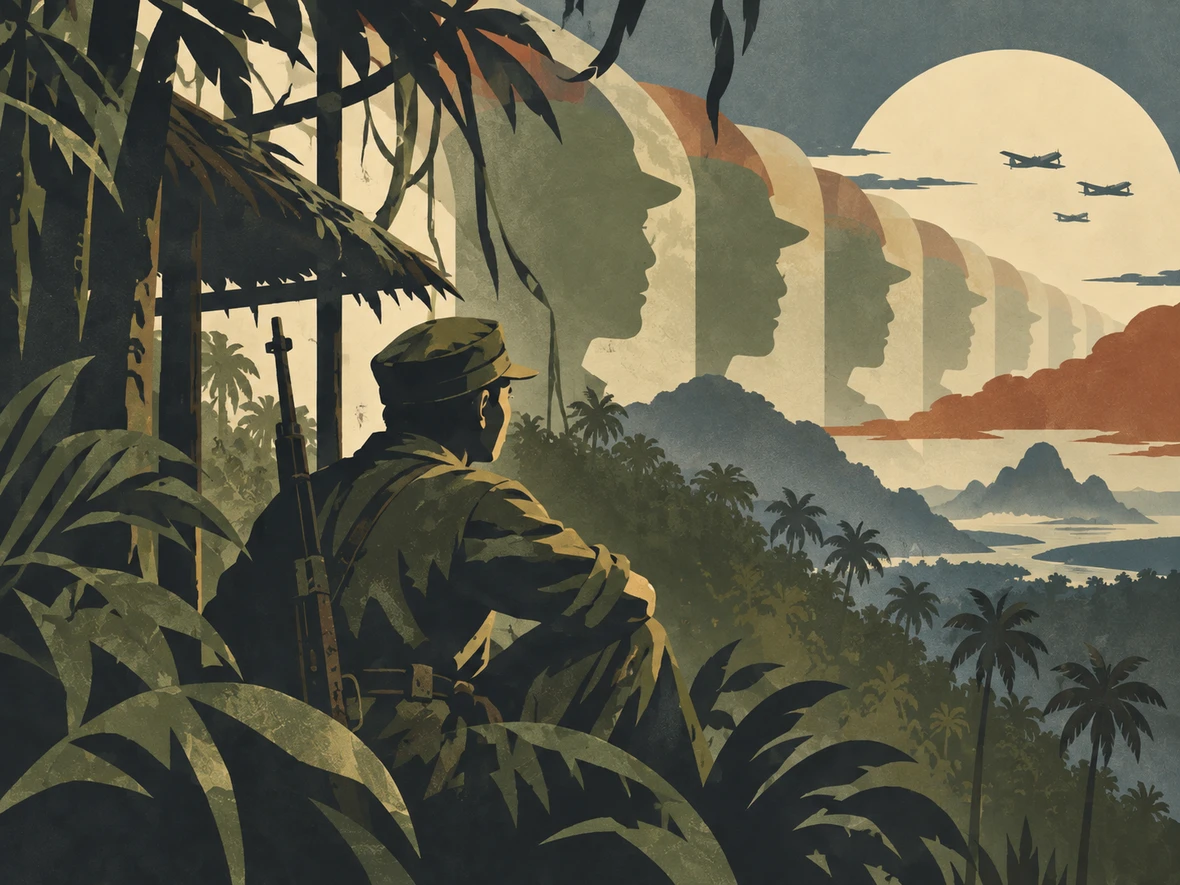
In 1944, Nakamura was sent south through the Japanese wartime network and eventually reached Morotai, an island in what was then the Dutch East Indies and is now Indonesia.1,2
Morotai mattered because of its location near the Philippines.
On 15 September 1944, American forces landed there and seized the area around the airfields. The Allies turned the island into a major base for the return to the Philippines.4
But they did not spend the rest of the war combing every metre of Morotai for every Japanese soldier.
The Australian War Memorial’s history is unusually blunt about this: once the Allied perimeter was secure, Japanese forces elsewhere on the island were largely left alone.4
Which is excellent news if your plan is to build an airbase.
Less excellent if you are one of the Japanese soldiers now living somewhere beyond it.
Nakamura disappeared into the interior with other surviving troops.1
And here is one of the strangest details in the whole story.
On 9 September 1945, a formal Japanese surrender ceremony took place on Morotai itself. Lieutenant General Fusatarō Teshima surrendered the Japanese Second Army to Australian General Thomas Blamey.4
There is newsreel footage of it.
Japanese officers sign the documents.
Allied personnel watch.
The war is officially over.

And somewhere on the same island, Nakamura does not come out.
Whether he could have known about that ceremony is another question entirely.
He later said he had not understood that Japan had surrendered and believed capture could mean death.1
For years, Nakamura remained with other Japanese holdouts.
Then, sometime around 1953 or 1954, he separated from the group and began living entirely alone.1
Why?
That part is disputed.
Nakamura later suggested that other men in the group had threatened him and that he left because he feared they might kill him.
Several former Morotai holdouts later denied that account.1
So this is one of those places where the responsible historical answer is:
we do not know exactly what happened.
What we do know is what came next.
For roughly twenty years, Nakamura had no direct contact with another human being.1
He built a small hut in a clearing and maintained a fenced field around it. Contemporary journalists later nicknamed the place “Nakamura City,” which is generous urban planning terminology for one hut and some crops.1,3
He grew food, fished, repaired what he could, and organized his life around the assumption that he still had to remain hidden. His own 1975 oral account goes into remarkable detail about the little world he built: the hut, the field, his attempts to keep track of time, the weather, illness and the constant need to avoid being noticed.3
He even claimed he had maintained an accurate calendar.
The problem is that some of his later answers suggest his sense of elapsed time was nowhere near as precise as he thought. Igarashi points out that Nakamura seems to have badly underestimated how many years had passed when discussing what had happened to his family.2
Which is understandable.
There is no particularly normal way to experience twenty years without speaking to another person.
Then, in 1974, somebody finally notices the clearing.
An Indonesian pilot flying over Morotai spots signs that someone is living in an isolated part of the island. The information eventually reaches the Japanese embassy in Jakarta, and the Indonesian authorities organize a search.1
On the morning of 18 December 1974, Indonesian personnel surround Nakamura’s clearing.1
They have a fairly unusual problem.
They believe the man inside may be a Japanese soldier who has spent decades expecting enemies.
Nakamura emerges.
He is fifty-five years old.
He does not resist.
At 8:15 that morning, according to the contemporary account later cited by historian Beatrice Trefalt, the search party reports back:
mission accomplished.1
Nakamura is taken out of the jungle and eventually flown to Jakarta, where doctors examine him.
After roughly thirty years on Morotai, he is suddenly being told what happened to the world.
Japan surrendered in 1945.
The emperor is no longer treated as divine.
The Japanese Empire is gone.
The Dutch East Indies is now Indonesia.
This is where his story becomes very different from Onoda’s.
Onoda came home to Japan.
Nakamura’s home had changed countries while he was away.
In 1945, Taiwan came under the control of the Republic of China. Under the postwar settlement, Taiwanese people who had been Japanese colonial subjects lost Japanese nationality. By the time Nakamura was found, he was no longer legally Japanese.1,2
And then, just to make the paperwork more pleasant, Japan had formally switched diplomatic recognition from the Republic of China on Taiwan to the People’s Republic of China in 1972.1,2
So Indonesian officials find a man who says he served Japan.
Japan recognizes him as a former Imperial soldier.
His birthplace is Taiwan.
Taiwan is governed by a state Japan no longer has formal diplomatic relations with.
And Nakamura himself has spent thirty years missing every single update.
Excellent administrative situation.
At first, even the question of where he should be sent becomes a public issue.
Some people in Japan argue that he should come to Japan and receive the same kind of welcome given to other holdouts. An organization is actually formed to campaign for a warm reception for him.1
Nakamura ultimately makes his own preference clearer.
He wants to go back to Taiwan.1
So on 8 January 1975, he lands in Taipei.2
And now the thirty-year gap becomes personal.
His baby son is no longer a baby.
He is a grown man with a family of his own.2
Nakamura’s wife had been told her husband was dead.
Years later, she remarried.2
According to Igarashi’s reconstruction from contemporary Taiwanese and Japanese reporting, the family reunion in Taipei initially happens before Nakamura fully understands the remarriage situation. The following day, on the way back toward his home area in Taitung, his wife tells him.2
He reacts badly.
Which is not especially surprising if, from your perspective, you left recently and your wife has somehow acquired an entire second marriage.
His internal clock and the actual calendar were not having the same week.
Eventually the situation settled. Nakamura did not attempt to destroy the life his wife had built in his absence, and he moved into the much quieter business of trying to exist in a society that had changed almost beyond recognition.2
But Japan now had another uncomfortable issue.
Money.
When Hiroo Onoda returned, he was an ethnically Japanese former officer who still fit comfortably inside Japan’s postwar legal categories for veterans.
Nakamura did not.
He had served the same empire, worn its uniform and remained at his post longer than Onoda.
But because he had been a colonial Taiwanese soldier and no longer held Japanese nationality, he was not eligible for the same pension arrangements.1,5
The Japanese government’s first calculation for his outstanding pay and return allowance came to about 68,000 yen.1,5
Thirty years.
Sixty-eight thousand yen.
Even in 1975, people looked at that number and went:
come on.
The contrast caused public outrage. Additional government support and private donations followed.1,5
But Nakamura’s case also opened a much larger question.
He was not the only Taiwanese person who had served Imperial Japan.
Roughly 200,000 Taiwanese had served in Japanese military or military-related roles during the war, and tens of thousands died. After the empire disappeared and their nationality changed, Taiwanese veterans and bereaved families had largely been left outside the Japanese compensation system.5,6
Nakamura’s return made that problem extremely difficult to ignore.
In 1975, activists including Taiwanese scholar Ong Iok-tek established an organization in Japan to push for compensation for former Taiwanese Imperial servicemen. The campaign moved from public advocacy to litigation and parliamentary pressure.5,6
The lawsuits failed.
The political campaign did not.
In 1987, Japan finally passed legislation providing special payments of two million yen to qualifying Taiwanese former servicemen with serious war injuries and to bereaved families of those who had died.5,6
Nakamura never saw that happen.
And I think that is why his story is much better than simply calling him “the real last Japanese soldier.”
Technically, yes.
He was the last confirmed Imperial Japanese Army holdout to be found after the war.1
But the interesting part is what happened when the last soldier finally came home.
The empire he served no longer existed.
The country he came from was governed by someone else.
The nationality under which he had gone to war had disappeared from his life without asking him.
And Japan had to work out whether thirty years of loyalty still counted when the person who gave it was from a colony Japan no longer owned.
That argument lasted much longer than the war did.