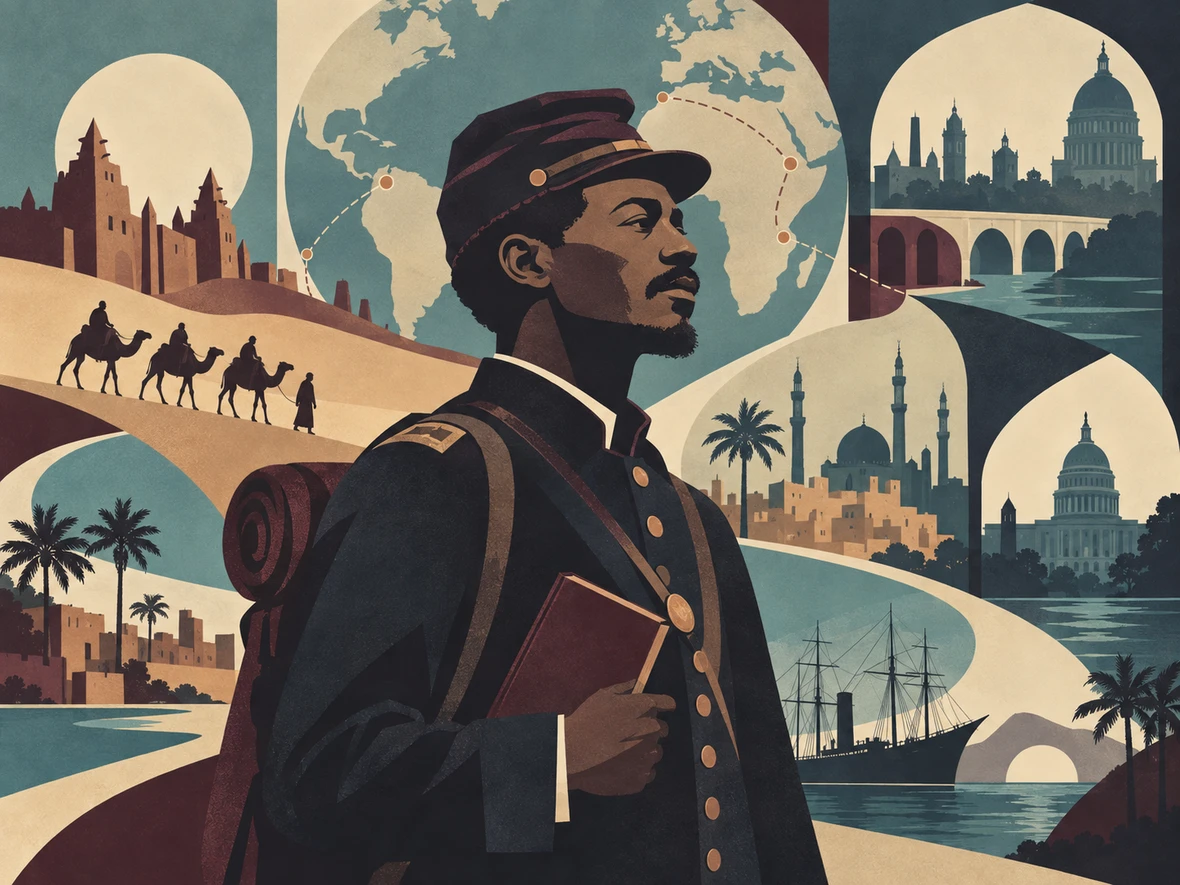
Nicholas Said’s life has one of those timelines where you occasionally have to stop and check that you haven’t accidentally combined three different people.
He was born the son of one of the most powerful military men in the Borno Empire.
Then he was kidnapped and enslaved.
Then he crossed the Sahara.
Then he went to Mecca.
Then Constantinople.
Then Russia.
Then Georgia.
Then Persia.

Then most of western Europe.
Then the Caribbean.
Then Canada.
Then the United States.
And after all of that, he joined a Black Massachusetts regiment and fought in the American Civil War.1,2,3,4
At some point the biography stops looking like a biography and starts looking like someone testing how many nineteenth-century maps they can fit into one book.
He was born around 1834–36 in Kukawa, capital of the Borno Empire near Lake Chad, in what is now northeastern Nigeria. His birth name was Mohammed Ali ben Said.1,2,3
And Said was not born poor.
Quite the opposite.
His father was the famous Barca Gana, one of the leading commanders serving the rulers of Borno. British traveller Dixon Denham had encountered Barca Gana in the 1820s and described his military importance. Modern historian Paul Lovejoy identifies him as a senior slave official and military governor within Borno’s political system.4
That phrase—“slave official”—needs explaining, because Borno’s system did not map neatly onto nineteenth-century American slavery.
Barca Gana was himself legally bound to the ruling household, but he held enormous power, wealth and military authority. He also owned many enslaved people himself. Borno’s armies participated in warfare, taxation raids and slave-taking, and Said grew up inside the elite that benefited from that system.4,6
So the beginning of Said’s life contains a pretty uncomfortable reversal.
He did not grow up outside slavery.
He grew up above most of the people trapped inside it.
Then he became one of them.
Said’s mother was a Mandara woman from a chiefly family. He grew up in a large household and received the kind of education expected for a boy in Borno’s military aristocracy. After his father’s death, he studied Kanuri and Arabic for years and learned to read religious texts.1,2
His own account says that after his schooling he was staying in another part of Borno and went into the countryside with a large group of boys.
Said had apparently been warned by his mother not to wander too far because raiders operated in the region.
He wandered too far.
A group of mounted kidnappers appeared.
The boys tried to hide.
Said fell while climbing down from a tree, lost consciousness, and woke up tied behind a man on horseback.1,2
Of roughly forty boys in the group, eighteen were captured.2
That is the moment Mohammed Ali ben Said’s childhood ends.
He was taken north and sold.
Then sold again.
And again.
The crossing took weeks.
The caravan moved through oases and rocky desert routes toward Murzuk, the commercial centre of Fezzan. Said’s 1867 account notices everything: irrigation systems, languages, buildings, the condition of animals, what people ate, how the caravan was organized.2
Which becomes a pattern in his writing.
This man could be having the worst month of his life and still apparently think:
Interesting municipal water system.
His first owner in Fezzan put him to agricultural work.
Said hated it.
Not because he had suddenly developed a principled objection to agriculture.
Because he had grown up in a household where enslaved workers did that kind of labour for his family, and he had absolutely no experience doing it himself.2,6
Eventually he told the owner who his father had been.
And the owner recognized the name.
He had known Barca Gana.2
Suddenly the teenage field worker becomes socially legible again.
His treatment improves.
He is sold to a young Ottoman officer who speaks Kanuri and starts teaching him Turkish. Then he is sent to Tripoli.2,4
And there, according to Lovejoy’s reconstruction of the longer autobiography, Said encounters some of the other boys who had been kidnapped with him.
Their families or connections had managed to ransom them.
They went home.
Said did not.4
That has to have hurt.
His new owner in Tripoli, Hadji Daoud, was a prosperous tobacco merchant who treated Said relatively well and took him on a long journey connected with pilgrimage.1,2,4
And I mean long.
They moved through Alexandria and Cairo, down through northeast Africa, across toward the Red Sea, onward to Arabia, and eventually to Mecca. Accounts of the exact itinerary differ in some details between Said’s versions, but there is no real dispute that his enslavement now carried him across a huge section of the Islamic world.1,2,4
Said had been raised Muslim.
But he later wrote that because he had not undertaken the journey freely as a pilgrim, he did not consider himself entitled to the honorific Hajji.2
On the return journey, his owner discovered that a fire had destroyed his business and much of his wealth in Tripoli.
This is another recurring feature of his life.
Major historical event for somebody else:
business burns down.
Result for Said:
new country.
He was sent toward Smyrna and Constantinople and entered the households of senior Ottoman officials. At one stage his job was essentially to prepare and clean smoking pipes.1,2,4
Then he came to the attention of Prince Alexander Menshikov, the Russian diplomat who would soon play a major role in the Crimean War. Said entered his service and travelled north with the Russian entourage toward St Petersburg.2,4
So in the space of a few years, Said has gone from Borno military aristocracy to kidnapped teenager to Saharan slave caravan to Ottoman household servant to the household of one of the most important Russian aristocrats of the period.
Normal adolescence.
Menshikov soon left for military command in the Crimean War, and Said moved into the service of Prince Nikolai Troubetzkoy.2,4
This becomes one of the better periods of his life.
Said was clearly gifted at languages, and living in elite households gave him opportunities to keep adding them.
By the time an American officer later met him during the Civil War, Said could communicate in an extraordinary range of languages—Kanuri, Arabic, Turkish, Russian, French, English and others to varying degrees.2
In 1855, while living in Russia, another major change happened.
He was baptized into the Russian Orthodox Church.
His name changed from Mohammed Ali ben Said to Nicholas Said.2
And Said’s own description of this is much less tidy than a standard nineteenth-century conversion story.
He says Prince Troubetzkoy meant well.
He says he remained grateful to him.
But he also says he did not properly understand what was being done and did not think the baptism had been handled correctly.2
Which is a remarkably careful way of saying:
I became Nicholas before anyone really checked whether Mohammed Ali understood the paperwork.
After the death of Tsar Nicholas I, Troubetzkoy gained permission to travel abroad.
And Said went with him.2
This produces several years where Said basically tours Europe from inside the servant staff of Russian aristocracy.
Warsaw.
Vienna.
Prague.
Dresden.
Munich.
Switzerland.
Italy.
Paris.
London.
And quite a few places in between.2
He wore elaborate Turkish-style clothing much of the time.
In Dresden, according to Said, local children had apparently seen so few Black people that crowds followed him when he went outside. He eventually started sitting with them and speaking to the ones who understood French, partly because trying to escape the attention by carriage was getting expensive.2
That is a very specific problem to have.
He also saw something in Europe that he had never expected as a child in Borno:
other Africans.
In Milan he encountered a man from near his home region—the first person from his part of Africa Said remembered seeing since his enslavement.2
During these travels, Said started thinking seriously about returning to Africa.
His idea was ambitious.
He wanted African states to acquire scientific and military knowledge from Europe without simply becoming possessions of European powers. In his 1867 narrative he imagines persuading rulers in the central Sudan to send young people abroad to study modern sciences and techniques.2
By 1859, he finally told Prince Troubetzkoy he wanted to leave and go home.
The prince tried to persuade him to stay.
Said refused.2
And this is the point where his enslavement effectively ends for good.
Said moved to London and stayed near the West India Docks while looking for passage toward Africa.2
He is finally free.
He has money.
He has a plan to go home.
Then a Dutch traveller appears and asks whether he would like to take a trip through the United States and the West Indies first.2
And Nicholas Said, whose life has already been derailed by approximately every transportation option available in the nineteenth century, says yes.
The trip takes Said through Boston and New York, then through the Bahamas, Haiti, British Guiana and several Caribbean islands, before returning to North America and continuing through places including Niagara, Toronto, Montreal and Quebec.2
Then the Dutch traveller runs out of money.2
Said lends him five hundred dollars.
He only gets three hundred and eighty back.2
And that missing one hundred and twenty dollars helps alter the rest of his life.
Said later wrote that the loss left him unable to continue the journey he had planned and forced him to find work in North America.2
Imagine crossing the Sahara as a slave, travelling through the Ottoman Empire and Imperial Russia, finally obtaining freedom, crossing western Europe and the Atlantic...
and the thing that strands you in North America is basically:
my travelling companion owes me money.
Then the American Civil War changed the country around him.
At first, Black men were generally excluded from federal combat service. Said had already seen Black soldiers in other military systems, and the restriction must have looked particularly strange to somebody whose own father had been a famous African commander.6
By 1863, policy had changed.
Massachusetts began recruiting Black regiments.
The famous 54th Massachusetts filled so quickly that the state organized a second unit, the 55th Massachusetts Infantry.5
Said travelled east.
On 8 June 1863, military records place Nicholas Said at Readville, Massachusetts, enlisting in Company I of the 55th.5
He was roughly in his late twenties.
The enlistment record gets some biographical details wrong—which is not unusual in Civil War paperwork—but the man is there in the federal record.
And there is a photograph of him in uniform.5
This is where his life loops back on itself in a way I almost don’t trust because it is too clean.
His father had been a military commander in Borno.
His father’s world had also profited from slave-taking.
Nicholas himself was then kidnapped and enslaved.
Now he voluntarily joins an army fighting a civil war in which the destruction of American slavery has become a central Union war aim.
Not as somebody enslaved in America.
Not as the child of American slaves.
As an African man who had already survived a completely different slave system on another continent.3,4,6
The 55th went south to the Department of the South.
It served around the coastal war in South Carolina, Georgia and Florida. The regiment worked in the siege operations around Charleston, including the long struggle around Morris Island and Fort Wagner, and later fought at Honey Hill in November 1864.5
The 55th also faced a fight with its own government over pay.
Black soldiers had been promised the same monthly pay as white troops but were initially offered less. The men of the 54th and 55th resisted the unequal arrangement, many refusing reduced pay until the dispute was corrected.5
Said rose from private to corporal and then sergeant. The 1867 account says that near the end of the war he requested duty with the hospital department because he wanted to learn something about medicine.2
And then he stayed in the United States.
That is important.
Because for years Said had talked about going back to Borno.
He had imagined taking knowledge home.
He had finally become free specifically intending to return.
And somehow every road kept bending somewhere else.
After the war, Said taught in the South and became involved in education during Reconstruction. Contemporary reports describe him teaching Black students and giving lectures about Africa and his travels.3,6
Then, in 1873, while living in the South, he published The Autobiography of Nicholas Said, a Native of Bournou, Eastern Soudan, Central Africa.1
It is more than two hundred pages long.
And it has a very strange hole in it.
Said’s earlier 1867 narrative had ended with an editor explicitly describing his service in the 55th Massachusetts. His military record exists. His wartime photograph exists.2,5
But in the later autobiography, Said rearranges the chronology of his arrival in America and leaves the Union Army out.1,3
Why?
We cannot ask him.
Recent historians treat the omission as one of the central problems in reconstructing his life. Mohammed Bashir Salau emphasizes that Said left two autobiographical versions that do not always agree.3
Dean Calbreath has argued that the political environment offers a very plausible explanation. Said was trying to live and work in the Reconstruction South, where openly advertising that you had served as a Black Union sergeant could be dangerous and professionally disastrous.6
So the version of Nicholas Said selling a book in the South becomes a man who arrived after the war.
The Union sergeant quietly disappears from his own autobiography.
Which is an extraordinary thing for someone to have to edit out of himself.
And then Said himself begins disappearing from the historical record.
We can follow him into the 1870s as a teacher, lecturer and author.
The 1880 census places a Nicholas Said from Borno working as a schoolteacher in Brownsville, Tennessee. Modern scholarship generally accepts that this is him.3,6
After that, things become murky.
Older references often give 1882 as the year of his death, apparently based on a later notation associated with his military record.
But the evidence is not strong enough to say with confidence exactly when or how Nicholas Said died. Salau therefore describes him, more cautiously, as eventually disappearing from sight.3
Which is a strangely appropriate ending.
Because we know an enormous amount about his movement across the world.
He tells us about Borno schools.
Saharan caravans.
Tripoli shops.
Ottoman households.
Russian aristocrats.
European cities.
Caribbean ports.
American regiments.
And then, after crossing five continents and writing down hundreds of pages of his own life, Nicholas Said simply becomes difficult to find.
But there is one thing I would not do with this story.
I would not end it by saying:
“the slave became free.”
Because it is much stranger than that.
His father was both enslaved and powerful.
His father owned enslaved people.
Nicholas grew up privileged by slavery and then became its victim.
He was converted from Islam under circumstances he later questioned.
He gained his freedom in Russia.
He planned to go home to Africa and instead crossed the Atlantic.
He joined the Union Army and then removed that service from the book he sold in the postwar South.
Every time a society gave Nicholas Said a category—aristocrat, slave, Muslim, Christian, servant, free man, African, soldier, teacher—his life kept moving until the category stopped being enough.
And somewhere around 1880, the record finally loses him.
After everything else, apparently history was the one place Nicholas Said actually managed to disappear.