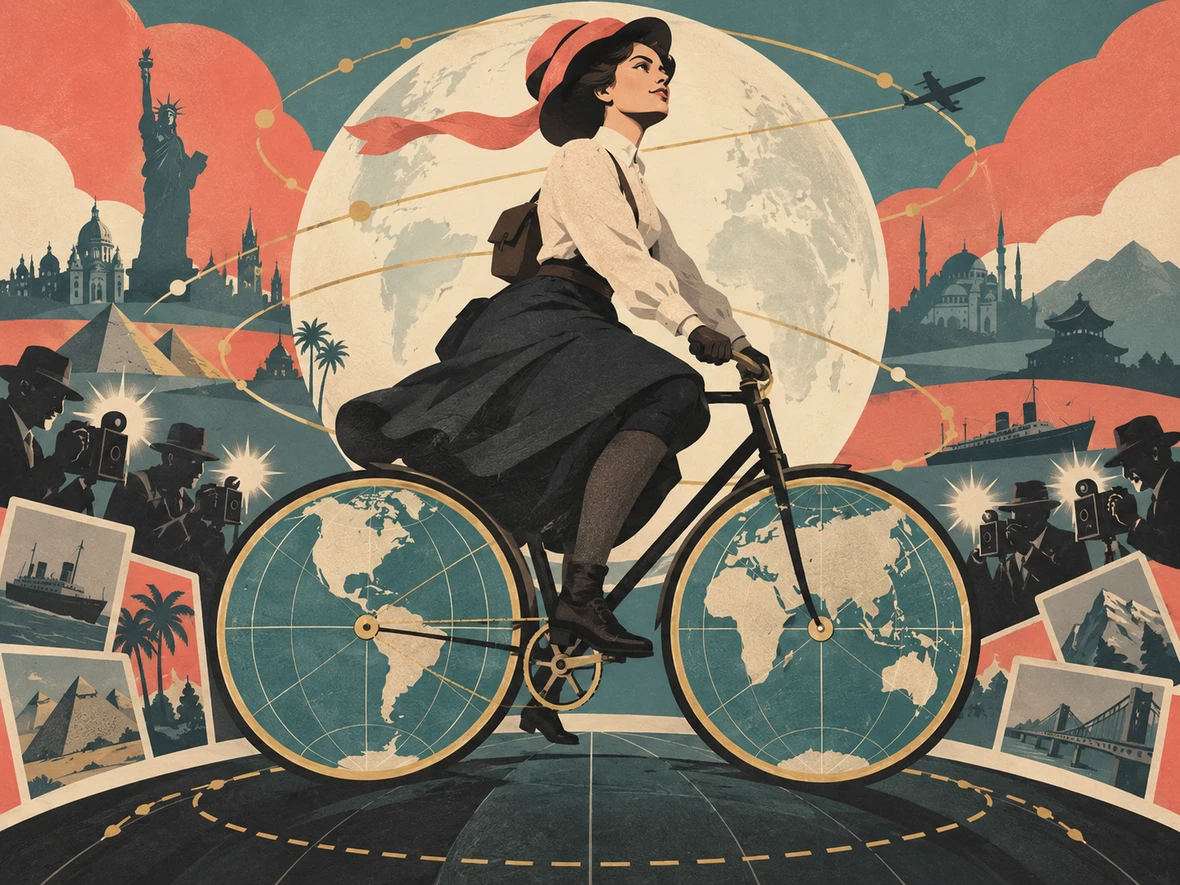
On 25 June 1894, a young Boston mother named Annie Kopchovsky left the Massachusetts State House on a bicycle and told the public she was going around the world.
Before the trip was over, she had changed bicycles, changed clothes, changed continents and—most profitably—changed her name.1,2
“Annie Londonderry” was advertising.
The Londonderry Lithia Spring Water Company paid her to put its placard on the bicycle and use the company name during the journey. The arrangement gave a Latvian-born Jewish immigrant from Boston an Irish-sounding public identity and turned the rider herself into part of the sponsor inventory.2,3
This was 1894, so the phrase “personal brand” had not yet become unavoidable.
The business model had already arrived.
Almost every version of Annie's story begins with a wager.
Two wealthy Boston men, never named, supposedly bet that no woman could circle the globe by bicycle within fifteen months while also earning $5,000 along the way. Annie accepted the challenge, and a $10,000 prize would be hers if she succeeded.1,2
It is a magnificent origin story.
There is one administrative weakness.
Nobody has ever found the bettors.
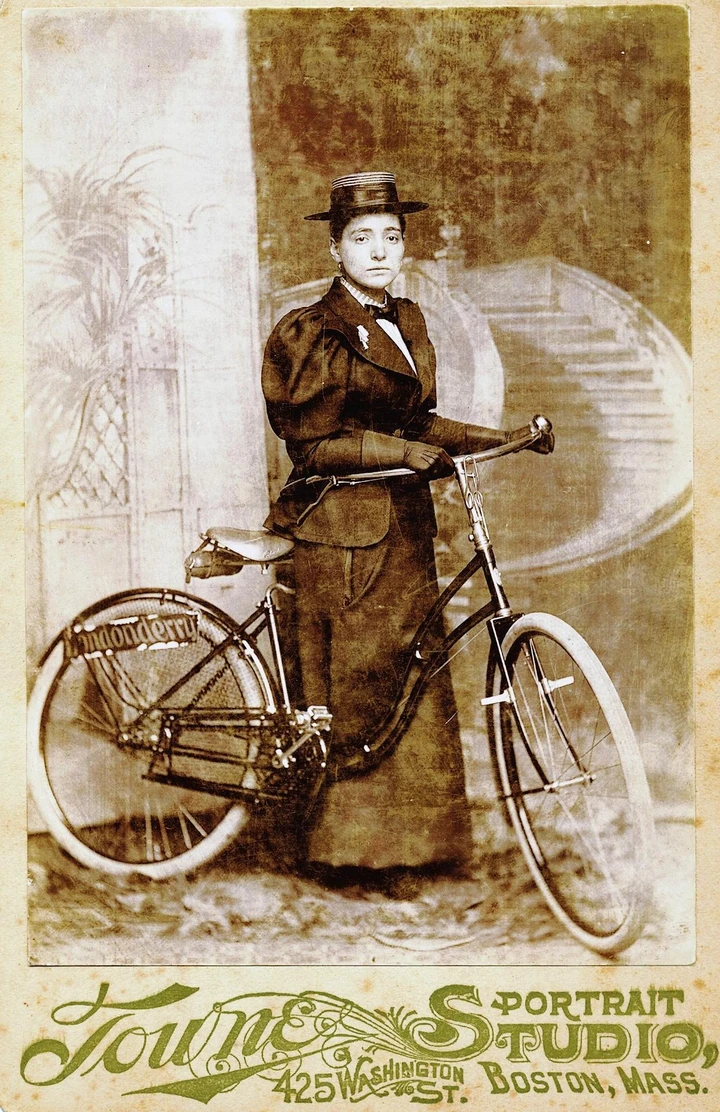
Peter Zheutlin, Annie's great-grandnephew, spent years reconstructing the journey through newspapers, letters, scrapbooks and family records. His conclusion is that the wager was probably invented as publicity. Contemporary stunt culture offered plenty of models for precisely that sort of claim, and the unnamed gentlemen never emerged to collect attention for having made one of the more expensive bets in Boston.2,3
So the safest version is also the more interesting one.
Annie may have launched an around-the-world trip by first selling the public a reason to care about it.
She was unusually well placed to understand that trick.
Annie Cohen Kopchovsky was born near Riga around 1870 and came to the United States as a child. She married Simon Kopchovsky and had three young children by the time of the journey. Zheutlin's research also places her in Boston newspaper advertising sales before the trip.2
That background mattered because a world journey costs money even when the central claim is that you intend to earn your way around it.
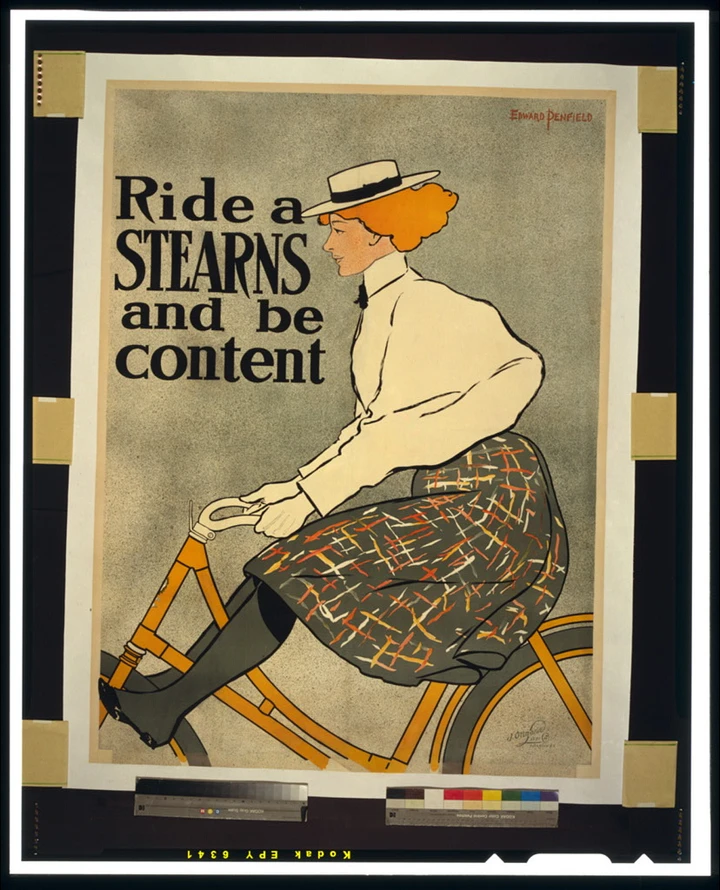
The bicycle itself had become one of the great consumer objects of the 1890s. The newer “safety” design—with two wheels of similar size and chain drive—made cycling practical for far more people than the old high-wheeler had. Women took to bicycles in large numbers, and arguments immediately followed about clothing, propriety, independence and whether civilization could survive the sight of a woman traveling somewhere under her own power.1,4
Annie entered that argument with excellent timing.
She left Boston on a heavy Columbia women's bicycle wearing conventional clothing for a respectable woman cyclist. The combination proved miserable for long-distance travel. By the time she reached Chicago months later, winter was approaching and continuing west across the mountains made little sense.2
A lesser publicity stunt might have ended there.
Annie redesigned it.
In Chicago she acquired a much lighter men's Sterling bicycle from Sterling Cycle Works and changed her riding clothes as well. The company gained a very visible moving advertisement. Annie gained equipment better suited to distance. A surviving 1895 Sterling advertisement explicitly presented “Miss Annie Londonderry” as making a trip around the world on a Sterling bicycle.5
The document is wonderful because it removes any possibility of pretending commerce was an embarrassing detail around the edges of the adventure.
Commerce was on the page in large type.
She then reversed direction, rode back toward New York and crossed the Atlantic by ship.

This decision is where the phrase “bicycled around the world” begins requiring punctuation.
Annie traveled around the world with a bicycle.
She also rode a great deal of it.
Those are not identical claims.
From France she cycled south toward Marseille, but the global route depended heavily on steamships and, at points, trains. She crossed seas by ship because bicycles remain poor ocean vessels. In Asia she made stops and local rides while continuing east through the shipping network. Contemporary and later accounts criticized the amount of non-cycling travel, while Annie's own publicity generally emphasized the global circuit rather than producing a modern endurance-sport mileage log.2,3
That ambiguity was useful.
The wager, if it existed, apparently left considerable room for interpretation. If it did not exist, interpretation became even easier.
Annie made the machinery of the trip interesting enough to sell, rather than pretending it was not there.
She carried advertisements. She sold photographs and souvenirs. She gave lectures. Local businesses could pay to attach themselves to the journey. Newspapers could fill columns with whatever Annie said had happened since the previous city.2,3
The stories became increasingly adventurous.
Some were plainly incompatible with the timetable.
Annie later described episodes in Asia and elsewhere that researchers have been unable to reconcile with ship schedules and documented locations. Newspaper reporters occasionally noticed. The further the tale moved from verifiable travel, the more confidently it could acquire dramatic scenery.2,3
Calling that simple fraud misses half the point.
Annie was producing a serialized public character.
The factual journey supplied the stage: she really did leave her family, cross continents and oceans, ride long distances, navigate unfamiliar cities, finance herself through publicity and return within roughly fifteen months. The invented or embellished material made the stage louder.2
Her audience did not have live location tracking.
It had newspapers.
That meant Annie could arrive in a city, give an interview, tell a story, sell an image of herself and move on before another newspaper's skepticism caught up. The communications network did not merely report the trip. It became part of how the trip worked.
The bicycle did the same thing.
Women cycling in the 1890s already carried symbolic weight. Critics worried about clothing and morality. Supporters saw the bicycle as a machine for mobility and independence. The Library of Congress's cycling collections preserve how intensely newspapers debated the “wheelwoman,” bloomers and the New Woman during exactly these years.1,4
Annie made those debates physical.
Her clothing changed because the practical demands of riding changed. Long skirts gave way to more functional cycling clothes and eventually a men's riding suit. Newspapers noticed because newspapers in the 1890s could apparently regard trouser width as a matter of public consequence.2,4
The costume also became part of the performance.
A woman crossing public space alone, earning money from strangers, arranging sponsorships and choosing how she would be photographed was already newsworthy. Doing it while visibly rejecting some conventions of dress made it easier to package as the New Woman on wheels.
Annie eventually reached San Francisco in March 1895 and began the long return across the United States.
This section of the journey produced substantial riding and substantial publicity. Local cyclists sometimes joined her. She lectured, sold material, sought sponsors and continued feeding newspapers stories. Her route carried her through California and the Southwest, then north and east toward Chicago.2
Travel was occasionally helped by rail.
Again, Annie was less interested in satisfying rules that later cyclists might impose on a circumnavigation than in satisfying the rules of the story she had sold in 1894.
On 12 September 1895 she reached Chicago.
A few weeks later she was back in Boston, almost exactly fifteen months after departure.2
The supposed prize remains as elusive as the supposed bettors.
The publicity does not.
A month after the journey, the New York World published Annie's first-person account under a headline calling it the most extraordinary journey ever undertaken by a woman. She turned the trip directly into journalism and briefly wrote under the persona of the New Woman.2,3,6
The trip had already generated sponsorship money, photographs, lecture income, publicity and a post-journey newspaper platform. Annie did not pedal every mile of a continuous line around the planet. She turned real travel, strategic transportation and a public persona into a global media event.2,3,7
Even the name followed the business model. “Annie Londonderry” sounded like the identity of the traveler, but it began as a contract with a spring-water company.
By the time the trip ended, the advertisement was the name history remembered.