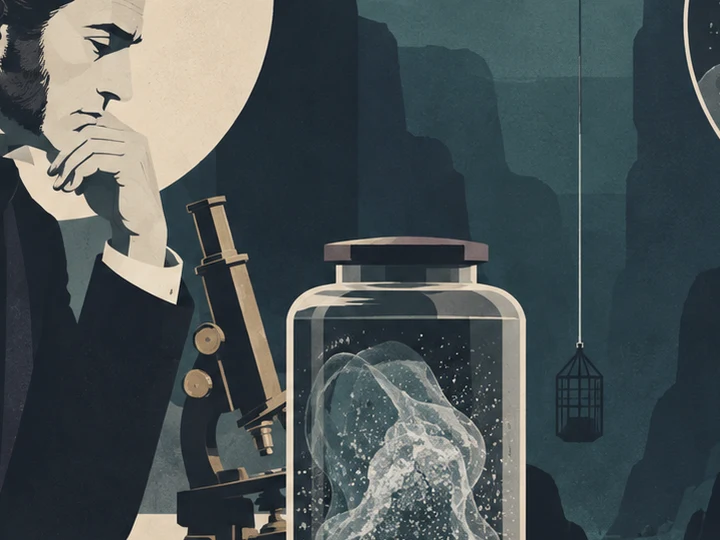
In 1832, Jeanne Villepreux-Power had a problem with Aristotle.
He had been dead for roughly two thousand years, so this was less personal than it sounds.
The problem was an octopus.
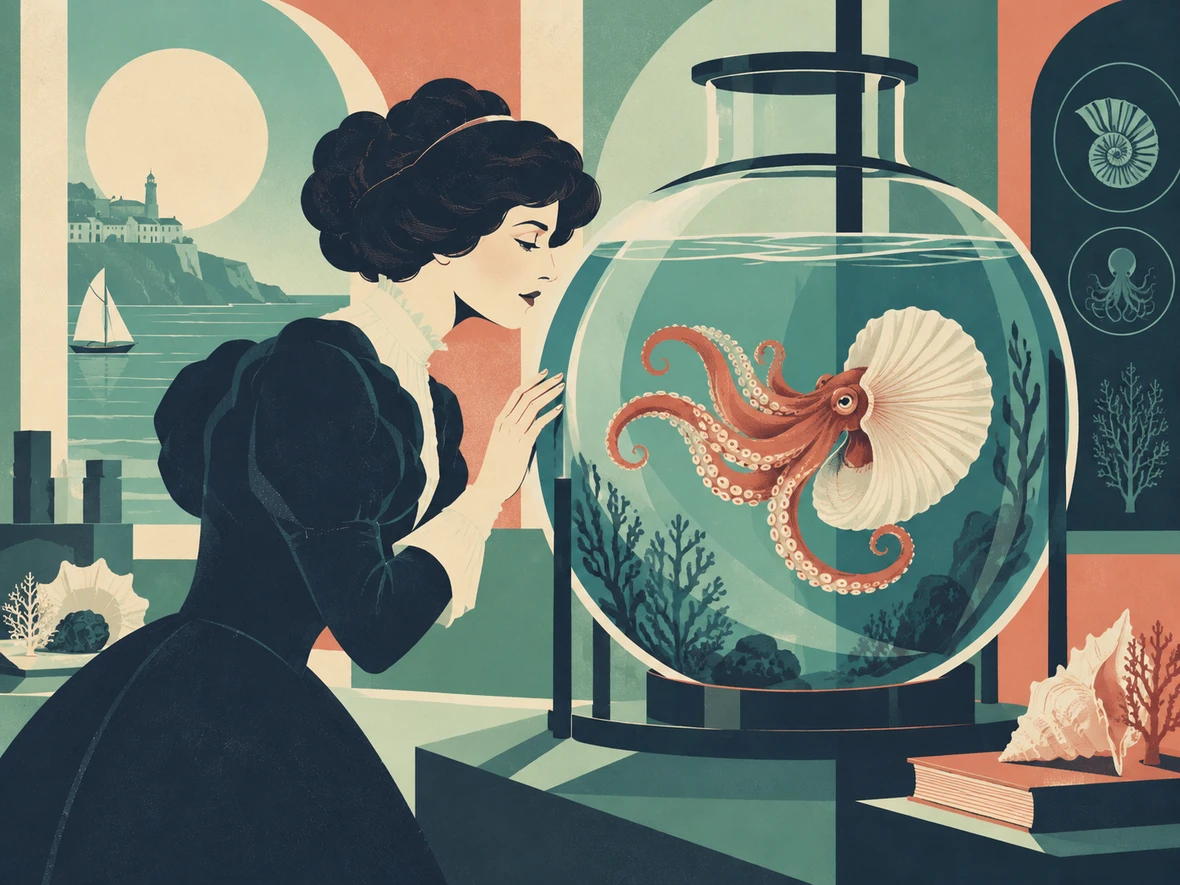
Specifically, Argonauta argo—the animal usually called the paper nautilus.
And that name is already unhelpful, because it isn’t actually a nautilus.
The female lives inside an absurdly thin, beautifully ribbed white structure that looks enough like a shell that naturalists spent centuries arguing over where it came from. Did the animal make it itself? Or had it simply found somebody else’s shell and moved in, essentially behaving like a very elegant hermit crab?
Aristotle had written about argonauts in antiquity and helped inspire another long-lived idea: that they floated at the surface using their broad arms like sails and the shell like a tiny boat. By the nineteenth century, scientists were still arguing about the animal’s relationship with the structure it lived in.1,2
And most of the people arguing had one fairly serious disadvantage.
They were studying dead specimens.
Jeanne’s answer was basically: keep the octopus alive and watch what it does.
Which sounds obvious now.
In 1832, it required her to invent the equipment first.
And that is how a French embroiderer from a small village ended up somewhere in the ancestry of the modern aquarium.1,3
Jeanne was born in Juillac, in southwestern France, on 24 September 1794.
Her mother, Jeanne Nicot, was a seamstress who could read and write and gave her daughter some of her earliest education. Her father, Pierre Villepreux, worked in several trades and gradually improved the family’s circumstances.1
There was no scientific dynasty waiting for Jeanne at home. No professor father leaving microscopes around the breakfast table.
In 1812, still a teenager, she left Juillac for Paris and found work in dressmaking and embroidery.1,6
And she became good enough at it to work on the ceremonial wedding dress of Princess Marie-Caroline of Bourbon-Sicily, who married the Duke of Berry in Paris in 1816.1
That is already a decent leap: from a small village in southwestern France to royal embroidery in Paris.
Two years later, her life moved again, this time to Sicily.
By 1818, Jeanne had travelled to Messina and married James Power, a wealthy merchant and entrepreneur of Irish background who had commercial interests there. They married on 4 March at the church of San Luca Evangelista.1,4
James made money through trade, insurance and industrial ventures, which meant Jeanne suddenly had something she had never really had before: enough time and money to pursue whatever interested her.
What interested her, increasingly, was natural history.
She began collecting and studying the plants, animals, rocks, fossils and shells of Sicily, and she travelled obsessively around the island doing it. She later wrote that she had crossed Sicily on foot, province by province, collecting both natural-history specimens and antiquities.1,6
She did not begin as a narrow specialist. For years she studied whatever caught her attention, including the development of more than two hundred kinds of caterpillars and butterflies, and her collections eventually became substantial enough that visiting scholars came to see them.6
By the early 1830s, though, the sea around Messina had become the part of Sicily she was most interested in.
It was an excellent place for that obsession. The Strait of Messina has complicated currents and a remarkable marine fauna, and local fishermen regularly encountered animals that scientists elsewhere might know mainly from jars, dried shells or preserved bodies.
The paper nautilus.
Again: octopus. Very inconvenient common name.
Jeanne began studying it seriously in 1832, walking straight into an argument that had been running for centuries.
One school of thought held that the octopus produced the shell-like structure itself. Another argued that the true builder was some unknown animal and that the argonaut merely occupied the empty case afterward. The prominent French zoologist Henri de Blainville defended versions of this parasitic interpretation.2,6
If all you have is a museum shell and a dead octopus removed from it, you can make either story sound plausible.
So Jeanne changed the experiment.
Instead of asking what the dead specimen looked like, she wanted to see what the living animal did over time—how it grew, how it behaved, what happened when its case was damaged, and what it did with its eggs.
That created a practical problem.
You cannot repeatedly bring octopuses out of the Mediterranean and expect them to remain useful research subjects in a bucket.
So Jeanne began having purpose-built containers made.
She used several designs. One was a glass vessel indoors, where she could watch small marine animals directly. Another protected a glass container inside an outer cage so it could remain submerged in the sea. She also used larger wooden enclosures that could be anchored underwater and raised when she needed to inspect the animals.1,3,6
The Sicilian scientific community started calling them gabioline alla Power—Power cages.

This is the point where saying “Jeanne invented the aquarium” needs one small footnote.
People had obviously kept fish and aquatic animals in bowls, ponds and vessels long before 1832. She did not invent the concept of putting an aquatic animal in water surrounded by walls.
What she pioneered was the systematic experimental use of purpose-built aquaria to study living marine animals, including glass observation tanks and submerged research enclosures. Richard Owen later argued that, if the invention of the aquarium could sensibly be credited to one person, Jeanne deserved that credit.1,3
Which is more interesting anyway.
She did not invent the aquarium because she wanted something tasteful next to the sofa.
She needed laboratory equipment that did not exist, so she had it made.
Then she started testing the octopus.
One of her key experiments was brutally straightforward.
If the argonaut merely stole somebody else’s shell, it should not be able to manufacture new shell material.
So Jeanne deliberately damaged parts of the shell-like case while the animal was alive.
The argonaut repaired it.
The female spread the broad membranes of two specialized arms over the damaged area and rebuilt the missing material. Jeanne repeated the observations at different stages and also kept young argonauts, following the relationship between the growing animal and its increasingly large case. Her collections included specimens showing development from tiny juveniles to full-sized adults.1,2,3
That becomes extremely difficult to explain if the octopus is simply wandering around the Mediterranean looking for vacant shells in exactly the right size.
The female made it.
Modern biology adds one important correction. The argonaut’s “shell” is not the same thing as a true molluscan shell such as a nautilus shell. It is an eggcase secreted by the female using those specialized arms. She lives in it and uses it, but biologically it is a very unusual reproductive structure.1,2
Jeanne was working before anyone had the modern evolutionary and developmental framework for explaining all of that.
But on the central question she was trying to settle, she was right.
The animal makes the thing itself.
And she did not stop there.
She followed egg development, recorded growth, watched how the animal positioned itself inside the case and tried to understand reproduction in a species with one of the more unreasonable size differences between males and females in the ocean.1,2
Female argonauts can be many times larger than males. The males are so small that nineteenth-century zoologists spent years being confused about which organisms actually belonged together.
Marine biology was having a difficult decade.
By 1834, Jeanne was communicating her results to the Accademia Gioenia in Catania.
And this is where her position becomes unusual.
She had no university degree, no professorship and no institutional laboratory. She was a self-taught woman working largely from her own home, with equipment she had commissioned herself and animals supplied in part through local fishermen.
The Academy took her seriously.1
In the mid-1830s, she became the first woman admitted as a corresponding member of the Accademia Gioenia.1
Then the argument over the argonaut started moving beyond Sicily.
Jeanne’s work reached French naturalists and appeared in scientific discussion. There were disputes over what exactly her experiments proved, who had first observed which behavior, and how much credit belonged to Jeanne herself.1,2,6
The strongest support eventually came from Britain.
Richard Owen was already one of the major comparative anatomists of his generation. Later he would become closely associated with the British Museum’s natural-history collections and, famously, coin the word Dinosauria.
But in 1839 he was standing before the Zoological Society of London talking about Jeanne Power’s octopuses.1,3
Jeanne had sent him preserved material documenting her experiments, including argonauts at different stages of growth and shells showing the results of damage and repair.1
So this was not simply a letter saying:
trust me, the octopus did it.
She had designed the evidence so that people outside Messina could inspect what she was talking about.
That mattered because a skeptical anatomist in London or Paris could not simply lean over her shoulder while the animal repaired its case. The specimens, drawings and reports had to do some of the travelling for her.
Owen presented the material in February 1839 and argued strongly that her experiments resolved the old shell question.1,3
By the end of the 1830s, Jeanne was no longer simply a wealthy amateur collecting interesting things around Sicily. She was corresponding with major naturalists, publishing results, joining scientific societies and having her experiments presented in London.
And then a ship sank.
Not the ship she was travelling on.
In some ways, worse.
In 1838, while the Powers were trying to shift part of their life toward Britain, Jeanne packed a major portion of her laboratory and collections into sixteen crates for shipment from Messina to London aboard the brig Bramley.1,4
Those crates represented years of work. They contained scientific books, specimens, fossil shells, equipment, drawings and other material, mixed with household property.4
The Bramley never delivered them.
This is where a lot of modern biographies accidentally move the disaster five years later and say it happened in 1843, when Jeanne permanently left Sicily.
There is also a second correction.
The wreck did not make Jeanne immediately throw down her notebook and retire from science forever.
Her husband became seriously ill around the same period, and the Powers returned to Sicily. Jeanne resumed argonaut observations in Messina in late 1839 and continued scientific work into the early 1840s.1,4
But she never rebuilt the full natural-history cabinet that had gone into the sea.
And that mattered enormously in nineteenth-century science.
There is no cloud backup here. If years of specimens, artwork, notes and equipment are packed into sixteen boxes on one ship, then a shipwreck can remove a large part of the physical record of your career in one afternoon.
Some of Jeanne’s work survived specifically because she had already sent material elsewhere. Owen had specimens. Academies held manuscripts and letters. Journals had published portions of her work.1,4,5
But much of the original material vanished, including a large amount of scientific artwork. Jeanne was a skilled illustrator, and the loss is one reason the small amount of visual material that survives today has become disproportionately important.6
Meanwhile, she was doing something else that does not fit neatly into the phrase “marine biologist.”
She was writing a guidebook to Sicily.
A serious one.
Her Itinerario della Sicilia appeared in 1839, followed by the much larger Guida per la Sicilia in 1842.1,6
The guide grew out of years of actually walking around the island. It covered antiquities, roads, towns and practical information for travellers, but Jeanne also folded in the natural history she had accumulated along the way. She explained what kinds of specimens could be found in different places, discussed Sicily’s flora and fauna, and included geological and fossil information alongside observations of the coast and Mount Etna. She even recorded local terminology that could help a traveller ask Sicilians for particular natural objects.6
Which is a very Jeanne solution.
If the available guidebook is not useful enough, apparently write another one.
In 1842, Jeanne and James finally left Sicily.
She continued writing from observations she had already made, including a major French account of the argonaut in 1856 and further zoological work in 1860.2,6
One of those later publications includes observations on the common octopus, Octopus vulgaris. Jeanne described the animal using stones while attacking Pinna nobilis, the large Mediterranean pen shell—an observation that feels surprisingly modern because researchers today care enormously about object use and problem-solving in octopuses.5
She also wrote about fisheries and proposed ways of raising young fish and crustaceans to restore depleted waters. Those proposals do not map neatly onto modern conservation biology, obviously, but the underlying concern is recognizable: if people keep taking animals from the sea, at some point you need to think about whether those populations recover.5
Then, in the 1850s, something slightly irritating happened.
Aquaria became fashionable.
Really fashionable.
British naturalists and the public became obsessed with miniature aquatic worlds maintained in glass tanks. Books appeared, home aquariums spread, and researchers who had never spent the 1830s cutting pieces out of an argonaut eggcase became very excited about the technology.3
Jeanne started seeing accounts that credited other people with inventing it.
So in August 1857, she wrote to Richard Owen.
The tone, once you strip away nineteenth-century politeness, is basically:
You remember I was doing this in 1832, right?
She reminded him that she had used multiple kinds of aquaria in her home and in the sea from 1832 onward and explicitly asked him to help protect her priority.1
Owen did.
In 1858, writing the entry on mollusks for the Encyclopaedia Britannica, he discussed earlier naturalists who had kept marine animals alive in containers and then drew the distinction that matters here.
Jeanne Power, he argued, deserved credit for the invention and systematic application of the receptacles now called aquaria to the study of marine animals.3
That wording is useful because it avoids one of those pointless historical arguments where somebody finds a Roman fishpond and announces:
actually, aquariums existed two thousand years earlier.
Yes.
Containers containing aquatic life existed.
Jeanne’s contribution was turning specially designed containers into an experimental method.
The aquarium as laboratory.
And it worked because it changed the kind of question you could ask.
A shell in a museum can tell you what a shell looks like.
A living argonaut in a tank can tell you what happens after you break it.
That difference settled a scientific argument that dead collections had not.
Jeanne spent much of her later life between Paris and London. She remained connected to learned societies and continued publishing, but the great period of Messina fieldwork was behind her.1,6
Then, in 1870, war reached Paris.
Prussian forces surrounded the city during the Franco-Prussian War.
Jeanne, now in her seventies, left and returned to Juillac—the village she had departed as a teenager nearly sixty years earlier.1,6
She died there on 25 January 1871.
James survived her by about a year.4
And then she mostly disappeared from the broader history of science.
Not because every trace vanished. Her publications remained. Owen had credited her. Sicilian academies preserved records. Letters and manuscripts survived in scattered collections.
But histories of the aquarium increasingly centered on later Victorian figures who developed and popularized balanced glass tanks in Britain.
Later researchers had to reconstruct the career from material spread across different places: correspondence, Academy records, her books, Owen’s reports, insurance documents from the lost shipment, and the specimens that had escaped the wreck because she had already sent them elsewhere.1,4
In 1997, the International Astronomical Union approved the name Villepreux-Power Patera for a volcanic feature on Venus.
One hundred kilometres across.8
Which is a fairly aggressive correction to obscurity.
But honestly, I think the aquarium is the better monument.
Because the clever part of Jeanne’s story is not simply that she guessed the correct answer about a strange octopus.
Plenty of people guess correctly.
She built a way to watch the answer happen.
She started with a question people had argued about since antiquity.
Then instead of writing one more opinion about it, she put the animal in a box and waited.