A railway passenger could buy one ticket for a journey that crossed several privately owned railway companies. That was convenient for the passenger. It created a less romantic question for everyone who owned the track: who, exactly, got how much of the fare?1
The Railway Clearing House was created in 1842 to answer that kind of question. Its immediate job was to allocate receipts from passengers and goods travelling across more than one company’s lines.1 Britain had acquired a railway network without first acquiring one railway company, so a through journey could be operationally continuous and financially fragmented.

That fragmentation became formal enough to require its own institution. The Railway Clearing Act of 1850 regulated the system, and later railway management literature summarized the Clearing House’s legal task as settling and adjusting receipts from traffic passing over more than one railway when it had been booked at a through rate or fare.2 The train could keep moving. The accounting had to catch up afterward.
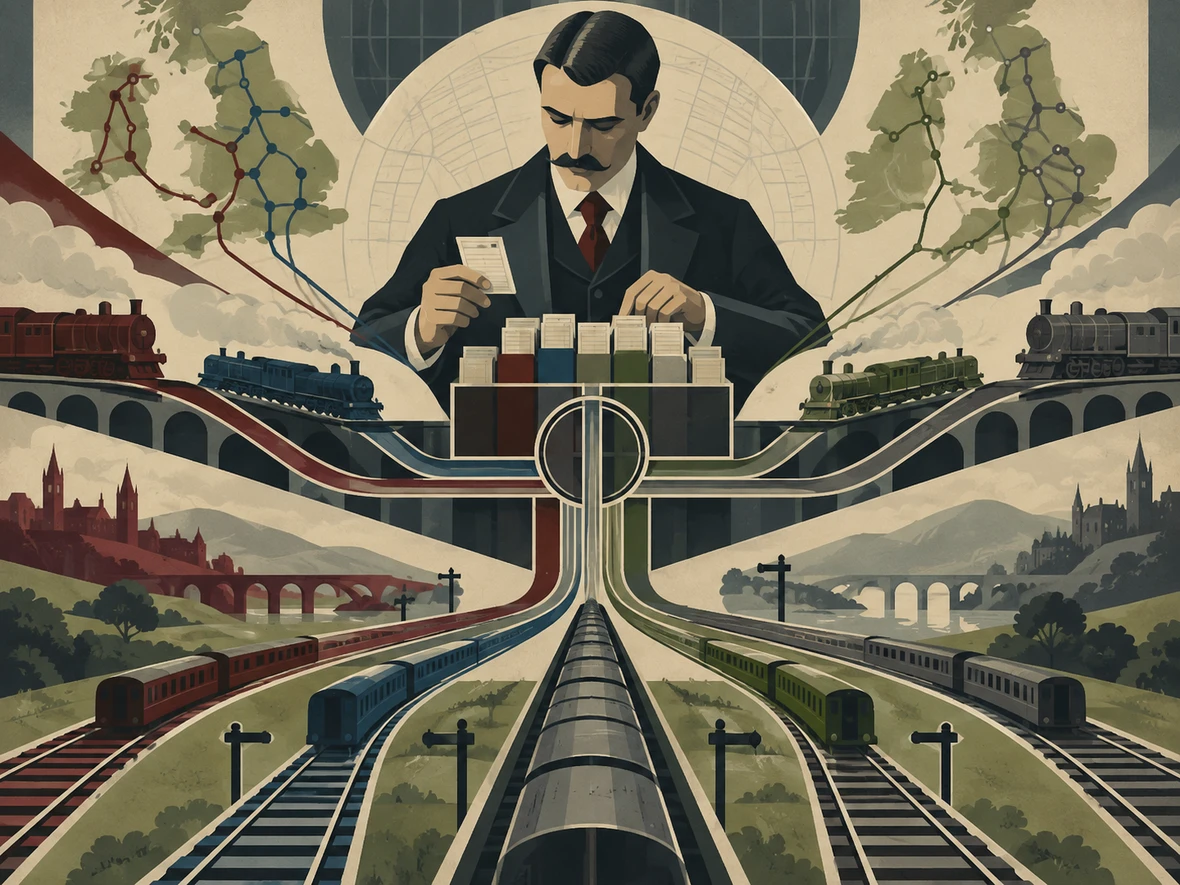
The Clearing House did not settle this by asking each company to remember roughly what seemed fair. Stations generated evidence. Goods traffic produced daily abstracts. Through passenger traffic produced returns and, importantly, the tickets themselves. A nineteenth-century account describes collected through tickets being sent to the London office, where clerks compared them with the returns of tickets issued and calculated the shares due to the companies involved.3
The ticket therefore had a second career after the passenger surrendered it. It stopped being permission to travel and became evidence in an inter-company account.
The scale rose quickly. Francis Bond Head’s contemporary description found 110 clerks handling the work and roughly 9,000 collected through tickets arriving for examination in a day.3 Goods, passenger traffic, the mileage of carriages and wagons, and even lost luggage all generated their own streams of paperwork. What passed through stations as trains arrived in London as bundles of tickets, abstracts and mileage returns.
The financial advantage was that dozens of bilateral claims could be reduced to balances. An 1856 description explains that stations sent returns covering through passengers, parcels, goods and rolling stock; after examination and analysis, the Clearing House told each company what it was entitled to receive and what it owed for using other companies’ vehicles, then settled the resulting balances through the companies’ London bankers.4
This mattered because the division was not always a simple matter of drawing a ruler along the route. A French observer in 1863 noted that several companies could have claims on one payment and that distance was not the only possible basis of division; terminal work and expensive infrastructure could also affect the allocation.5 By then the same observer counted 550 clerks in the central administration and another 250 working in the provinces. The effortless through journey was producing a fairly strenuous amount of arithmetic.
The Clearing House also became useful for problems adjacent to the original settlement job. It developed common goods classifications and helped standardise other railway practices.6 Those later functions should not obscure the basic invention: separately owned railways could sell a journey as one movement because there was somewhere neutral to reconstruct the money afterward.
Even the great company amalgamations of 1923 did not immediately remove that need. With the network reduced to the Big Four, the Clearing House continued coordinating pricing and freight practices between firms that were still separate businesses.7 Fewer companies made the problem smaller. They did not make it disappear.
For the passenger, though, none of this needed to be visible. At the destination, the traveller handed over the ticket and walked away. The ticket went to London.3