Refrigeration sounds like a property of equipment. Put food in a refrigerator, make the refrigerator cold, and the problem appears solved. Mary Engle Pennington built much of her career around demonstrating why that description was too small.
Food can be chilled at one point and mishandled at the next. It can leave a producer in good condition, warm during transport, cool again in storage, sit too long at a wholesaler and arrive at a shop with a perfectly respectable history of having been refrigerated several times. Bacteria are not especially impressed by the average.
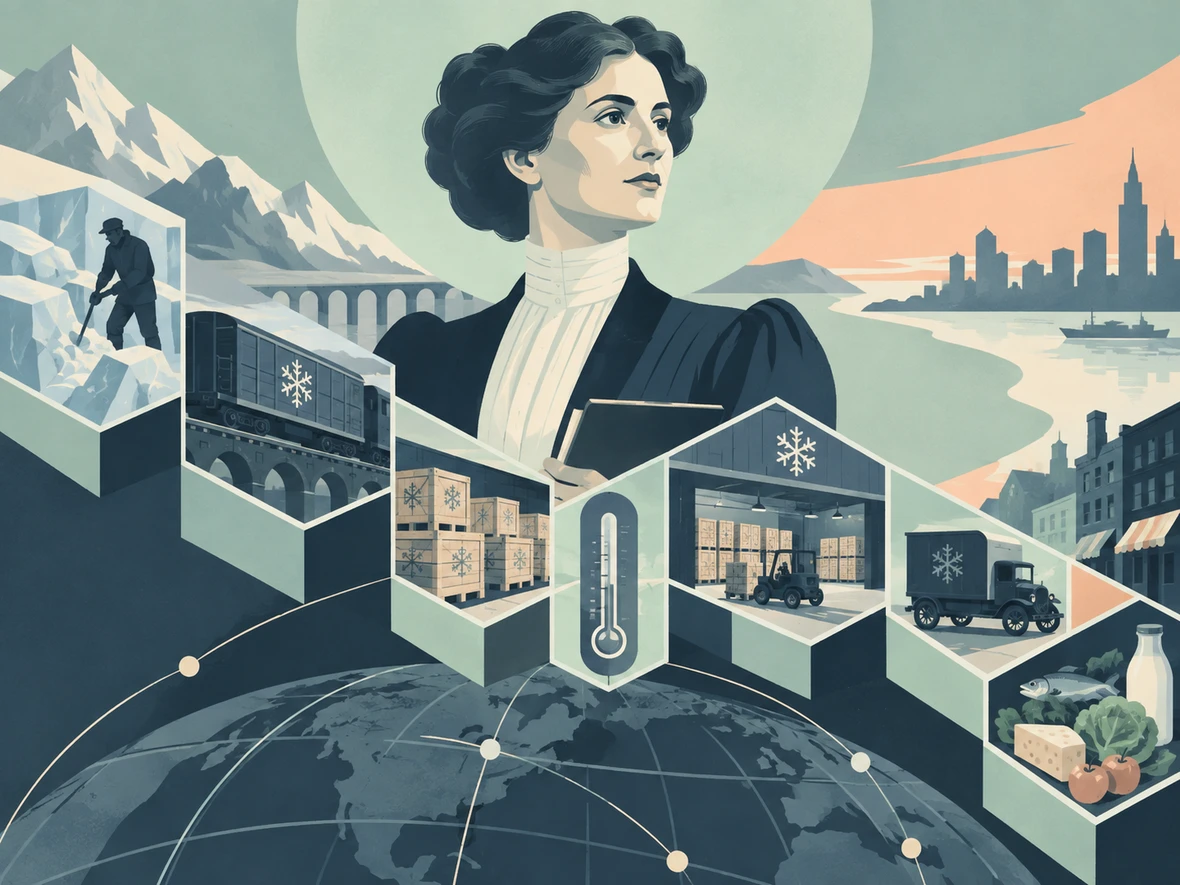
Pennington’s work for the U.S. Department of Agriculture put the emphasis on continuity. The FDA’s historical account describes her Food Research Laboratory research as showing that fresh foods kept much longer when low temperatures were maintained without damaging fluctuations.1 The important object was therefore not one cold room. It was the route from production to consumer.
Pennington entered federal food work after training in chemistry, bacteriology and related fields and running a clinical laboratory in Philadelphia. She joined the USDA in 1905 and became chief of the Food Research Laboratory after the Pure Food and Drugs Act created new enforcement problems for the Bureau of Chemistry.1 The National Agricultural Library’s Pennington collection is revealing simply in its scope: her papers include work on the handling, refrigeration, transportation and distribution of perishable foods.2 Those are four different nouns for what can go wrong after something leaves the farm.

Poultry and eggs made the problem especially concrete. Urban consumers wanted them year-round, while production regions could be hundreds or thousands of miles away. Pennington and her colleagues studied what happened from slaughter and packing through storage and rail shipment. Science History Institute’s reconstruction emphasizes that products sometimes entered storage already in poor condition and then spent long periods in inadequately refrigerated cars and warehouses.3 Cold storage could preserve quality. It could also preserve the consequences of bad handling if the food reached the cold room too late.
Pennington’s answer was not one invention. She worked on handling practices, cooling equipment, storage conditions and transport. A 1913 USDA bulletin, The Refrigeration of Dressed Poultry in Transit, survives in the National Agricultural Library’s historical collections as one piece of that larger program.4 The title is almost a summary of her method: refrigeration had to continue while the food was moving.
The railcar was a particularly awkward link because continuity had to survive movement as well as storage. A car could contain ice and still fail to keep its cargo uniformly cold. Air had to circulate; loading affected cooling; insulation mattered; and a train moved through changing outside temperatures while nobody in a laboratory could politely ask the chicken to remain in controlled conditions.
When the United States entered the First World War, the problem became national logistics. Science History Institute reports that Pennington joined wartime work examining refrigerated railcars and found that many performed badly.3 The details vary across later accounts, but the broader point is well supported by institutional histories: refrigeration standards had to include the vehicle, not merely the warehouse at either end. The National Agricultural Library’s history of congressional agriculture likewise credits Pennington with standards for railroad refrigerator cars and methods for preserving and handling perishables.5
Her work kept extending outward. After leaving federal service in 1919, Pennington continued in refrigeration research, consulting and industry organizations. The National Agricultural Library records later work with the Household Refrigeration Bureau.2 The FDA notes that she continued into food preservation and frozen foods.1 The chain eventually reached the home. A perishable product could survive farm, railcar, warehouse and shop and still lose the argument in the final icebox.
Describing Pennington only as an inventor misses the size of the system she was working on. She did design equipment, including poultry-cooling apparatus, but hardware was useful only when it fitted a continuous system of sanitation, temperature control, transport and storage.3 Refrigeration was infrastructure disguised as a collection of boxes.
One correction follows from that framing. Pennington did not personally invent the American cold chain from nothing. Refrigerated transport, cold storage, ice industries, food inspection and bacteriology all involved large networks of engineers, businesses, officials and workers. Her importance lies in treating those pieces as a connected scientific problem and developing standards and evidence that could make the connections more reliable.
Modern supply chains make that logic easy to overlook because continuity is supposed to disappear into the background.
A refrigerated product is expected to arrive cold, and the consumer is not asked to admire every warehouse, railcar, loading practice and temperature decision that made the uneventful arrival possible.
Pennington’s career helps explain why uneventful became an achievement. The cold box was never enough. The food had to stay inside a cold system even while the system was moving.