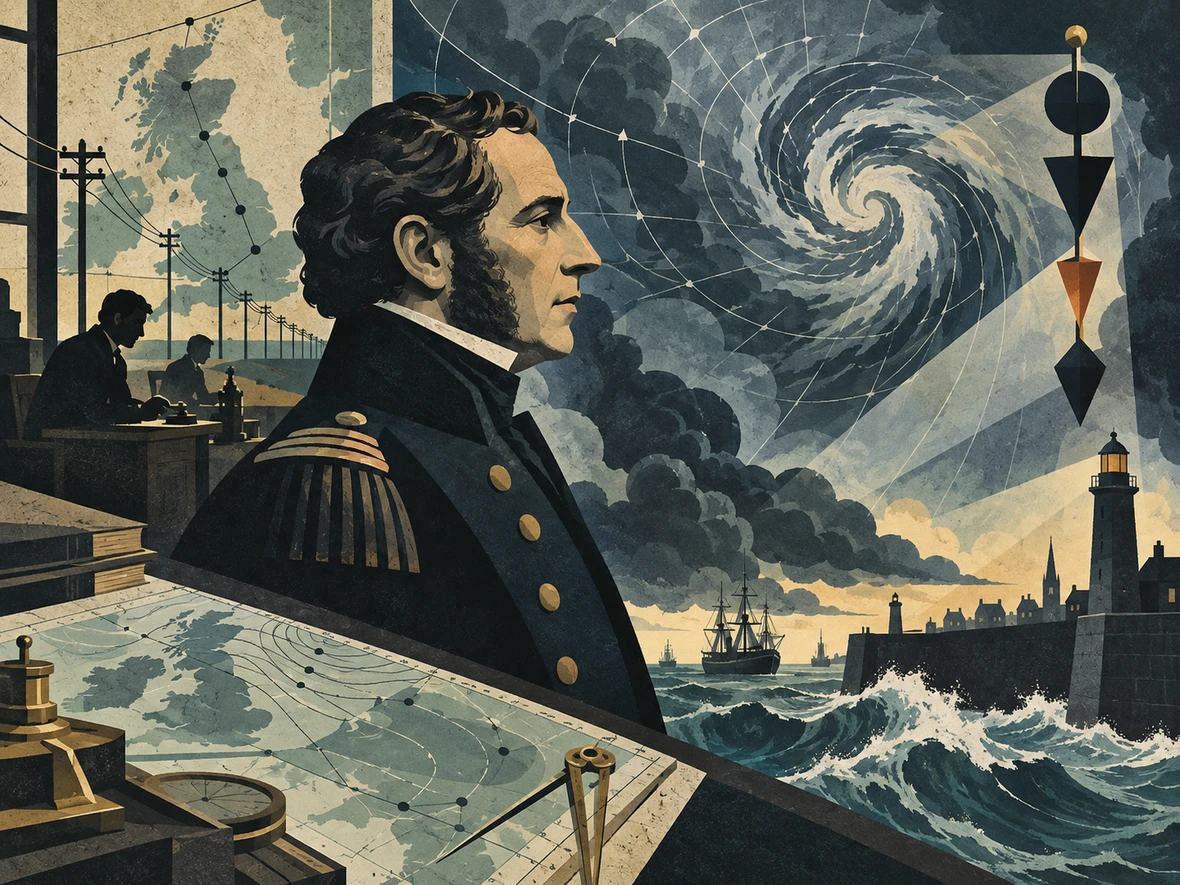
In 1860, the Meteorological Office acquired an advantage over the weather: the electric telegraph. Coastal observations could reach London before the same weather reached another part of the coast.1
Robert FitzRoy had been running the Board of Trade's meteorological work since 1854, when the department's main business was marine observations and climatology. The wreck of the Royal Charter in the gale of October 1859 changed the argument. FitzRoy used the storm and other cases to show that dangerous weather could be tracked across a network rather than discovered one harbour at a time.1
The useful trick was speed. Reports from around the coasts were sent to the Meteorological Office by telegraph and assembled into Daily Weather Reports; the earliest known surviving report in the archive is dated 3 September 1860.2 The office could compare conditions in different places while the atmosphere was still moving between them.
London then had to send the conclusion back out. If FitzRoy judged that a gale was likely, the warning had to reach the threatened coast quickly enough to matter.3

The answer used the same telegraph in reverse. A warning was sent to the relevant coastal station, where it became something a ship could see: canvas cones and drums hoisted from a mast or other prominent point.4 The signal could then be repeated by coastguard or other authorised stations along the coast.4 The warning network therefore ended in a piece of geometry hanging in the air.
On 5 February 1861 the first telegraphic storm warning was issued.1,4 This was a maritime danger warning rather than a general daily forecast: particular coasts were judged to face dangerous weather, and the signal was meant for people deciding whether to put to sea.
FitzRoy's better-known public forecasts came later. On 1 August 1861 he published a forecast in The Times for the general public, using the same expanding stream of observations but without the government authorization he had for the storm-warning service.2 The warning network and the newspaper forecast were related experiments with different purposes and different launch dates.
A warning could reach a harbour without keeping a ship there. Ports still had to receive the telegram and display the signal, and each mariner still chose whether to act on it. The network moved information quickly; obedience remained stubbornly local.
FitzRoy's service became popular with maritime communities while scientific criticism of forecasting persisted. After his death in 1865, the storm-warning service was curtailed on 7 December 1866 following the controversial Galton report.3
Public pressure and questions in Parliament followed. The warning service returned from 30 November 1867, and the first warning after the restoration was issued on 10 January 1868.3