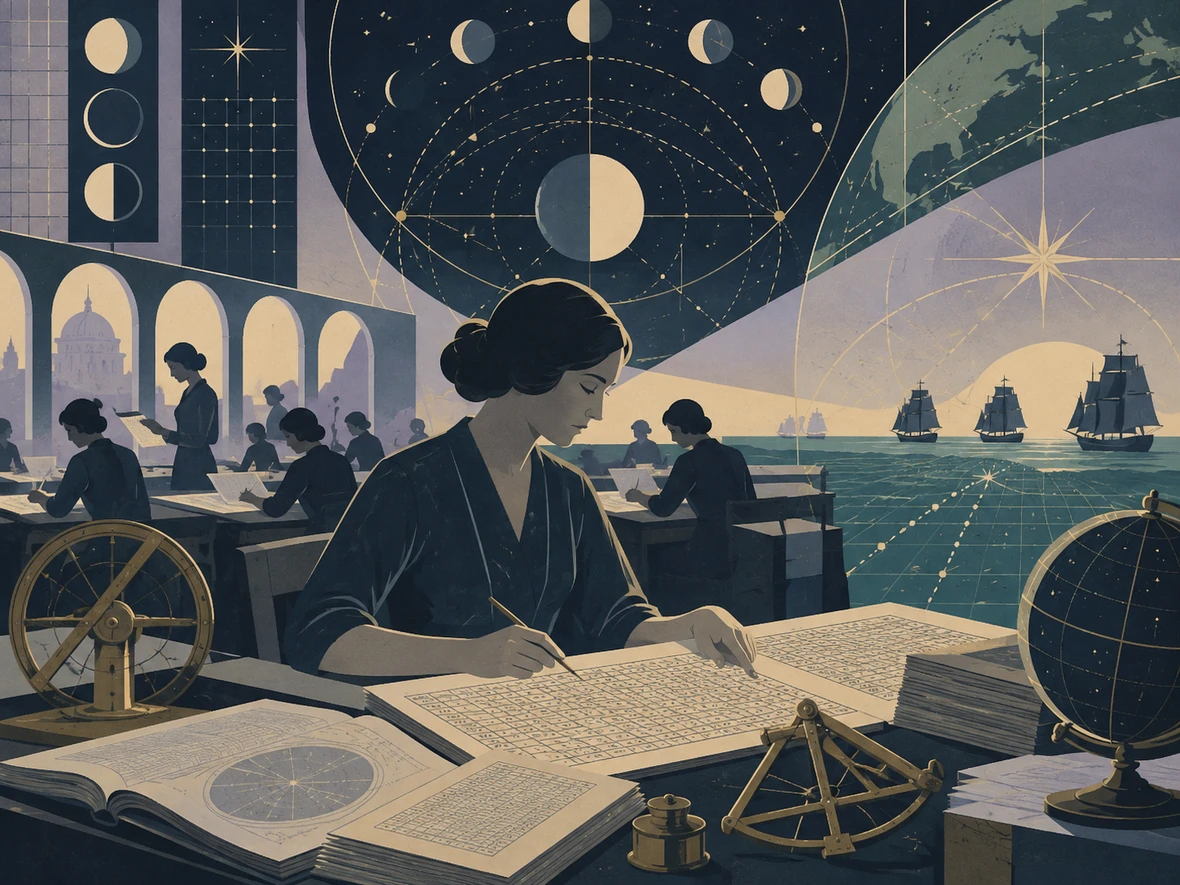
In the eighteenth century, Britain produced an annual navigation book with a quality-control system that began by assuming the person doing the arithmetic might be wrong.
That was sensible. The Nautical Almanac depended on enormous quantities of hand calculation, and a small numerical error could survive very attractively in print. Under Astronomer Royal Nevil Maskelyne, calculations were assigned to human “Computers,” independently checked and passed to “Comparers” whose job was to find disagreements before the figures reached mariners.1,2
The word sounds more futuristic than the working conditions. During Maskelyne’s tenure, between four and nine Computers might be working on the Almanac at one time. They worked from home, some near London and others scattered across England. Royal Observatory records describe the qualifications in less celestial terms than one might expect: strong numeracy, the ability to use mathematical and astronomical tables, attention to detail and neat handwriting. Formal astronomical expertise was not essential.2
The product existed because longitude at sea was partly a calculation problem. The lunar-distance method used the observed angle between the Moon and another celestial body to help establish Greenwich time and therefore longitude. Maskelyne had tested the method at sea, but the arithmetic was laborious. Precomputed tables of the Moon’s future positions could move much of that work ashore before a voyage began.3
Maskelyne became Astronomer Royal in 1765. The first Nautical Almanac was printed under his supervision in 1766 for the year 1767, supplying solar and lunar ephemerides and other tables for navigation and astronomy.4 The book put future positions of celestial bodies into a form that could travel aboard a ship. Producing that convenience for the navigator required somebody else to do the inconvenience in advance.
The checking system was deliberately redundant. Contemporary Observatory history describes each calculation as being done independently by two Computers; if their results differed, the discrepancy went to the Comparer.5 A disagreement was therefore not an embarrassing accident outside the system. It was one of the things the system had been built to expose.
Cambridge’s recent history of the Board of Longitude describes Maskelyne directing a group of mathematical Computers overseen by Comparers, with hierarchy, costs and production management becoming recurring concerns for the Board. The tables could be calculated years ahead.1 Astronomy had acquired deadlines, distributed labor and a paid checking layer devoted to discovering that two answers to the same question were not, in fact, the same answer.
One of the home workers was Mary Edwards of Ludlow, employed from 1795 until Maskelyne’s death in 1811.2 Her presence also corrects the easy mental picture of an all-male calculating room at Greenwich. There was no such calculating room yet. The Almanac needed people who could work carefully with tables, follow prescribed methods and produce results clear enough for somebody else to check.
The distinction between calculating and comparing mattered because printing created another opportunity for error. The final authority aboard ship would be a published table, not the private arithmetic that produced it. The Board was therefore manufacturing trustworthy numbers through stages: computation, independent verification, comparison, preparation for print and publication. The finished book concealed most of that labor rather efficiently.

It also concealed geography. A mariner could consult one compact annual volume whose figures had been produced by people working at separate tables around England. The information looked centralized because the publication was centralized. The arithmetic was not.
The system changed after Maskelyne died in 1811. Management of the Almanac became a recurring institutional problem. The Longitude Act of 1818 created a salaried Superintendent of the Nautical Almanac, and responsibility passed to Thomas Young rather than remaining directly with the Astronomer Royal.1,6 After Young’s death in 1829, John Pond briefly resumed responsibility. William Stratford became Superintendent in 1831.6
Stratford then changed the physical organization as well as the title at the top. In late 1831 or 1832 he established a separate Nautical Almanac Office to oversee production, reporting to the Admiralty.6