There are worse retirement packages than a lifetime room at Windsor Castle.
James Holman got one in 1812.
He was twenty-five, a Royal Navy lieutenant, and newly blind. The arrangement was called the Naval Knights of Windsor: former naval officers received accommodation and support, and in return their main regular obligation was attendance at chapel.1,6

For most people in Holman’s position, that probably sounds like a fairly decent landing.
Safe housing.
A pension.
Windsor Castle.
Very little chance of being shot at.
Holman hated it.
Not the castle specifically.
The staying put.
And this becomes a problem for essentially everyone who spends the next forty years trying to decide what James Holman ought to be doing with his life.
He was born in Exeter in 1786, the son of an apothecary. At twelve he entered the Royal Navy as a first-class volunteer. By 1807 he had become a lieutenant.1
Then, while serving aboard HMS Guerriere on the North American station, he developed a serious illness.
The exact diagnosis is not known.
His joints became painfully affected. His health deteriorated. And over the next period his sight failed completely.1,5
By twenty-five, his naval career was effectively finished.
Which is why the Windsor appointment made sense.
The Navy could no longer employ him in the ordinary way, and the Naval Knights system gave disabled officers somewhere respectable to go.1,6
Holman responded by asking for permission to leave.
He studied for a time in Edinburgh, including medicine and literature, and discovered something slightly inconvenient about his health: he often felt better when he was moving around.1,5
So in 1819 he went abroad.
Not on some carefully managed medical excursion with six attendants.
He travelled through France, Italy, Switzerland, parts of Germany, Belgium and the Netherlands.4
And he very quickly developed his own way of doing things.
He used a metal-tipped walking stick to read the ground and obstacles around him. He asked questions constantly. He touched architecture, machinery and geological features. He listened to echoes, street noise, voices and changes in the sound around him.1,5
Sometimes he improvised in ways that sound less like disability accommodation and more like something invented by a man who had become tired of waiting for other people.
On one coach journey, when the driver refused to stop long enough for Holman to get some exercise, Holman got out anyway, tied a piece of cord to the back of the coach and walked behind it for several miles.4
Apparently the villagers found this extremely funny.
Holman seems not to have cared.
In Italy he decided to climb Vesuvius.
People warned him that this was difficult.
Holman’s response, in his own published account, was that he intended to try it even if he had to go alone.4
He made it high onto the volcano at night, reaching an extinct crater and continuing until his guide refused to take the party farther toward the main crater without daylight.4
So the first major journey teaches Holman something fairly dangerous for everyone hoping he will settle down.
This works.
He goes home and publishes a travel book.
Then he comes up with a larger plan.
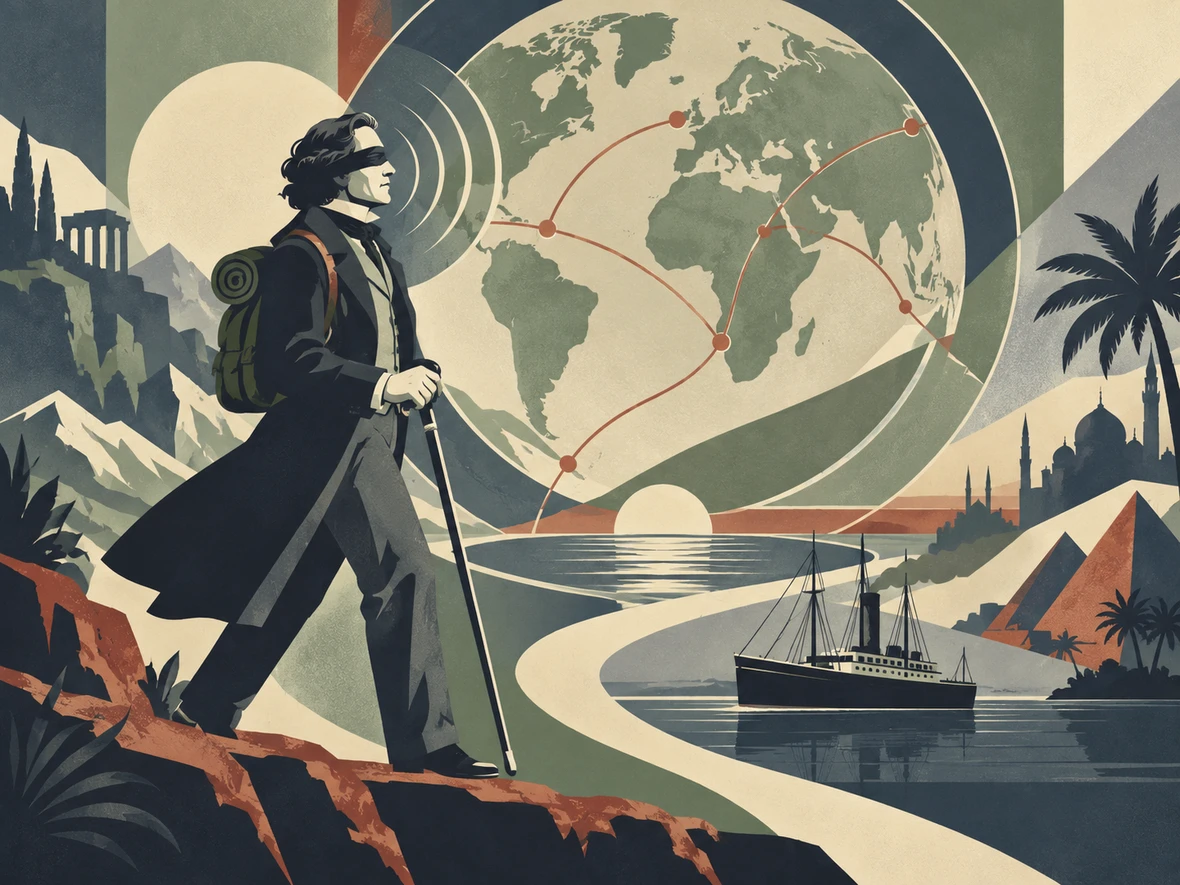
Go around the world.
In 1822.
Blind.
And Holman does not choose the easy direction.
He heads east across Europe into Russia, intending to cross Siberia and continue toward the Pacific.2
He reaches St Petersburg.
Then Moscow.
Then keeps going.
Across enormous distances by carriage and sledge, through places most British travellers at the time knew mainly as names on maps.2,7
Tobolsk.
Tomsk.
Irkutsk.
By the time Holman reaches eastern Siberia, the Russian authorities have developed a question.
Why is this British naval officer travelling across Russia asking people detailed questions about places, roads, trade and geography?
And there is a second question.
Is he actually blind?
Because from a Russian security official’s perspective, “I’m a completely blind Royal Navy lieutenant travelling alone toward the Pacific because I enjoy tourism” does have a slight disadvantage as a cover story.
It sounds insane.
Which, unfortunately, also makes it sound quite good.
Exactly what the Russian government feared he was collecting is less certain than some later retellings make it sound. You will sometimes see a very precise story that they were protecting secrets of the Russian-American Company. That is possible, and it fits the geopolitical setting, but the surviving evidence is much clearer about the suspicion of espionage than about one single classified subject Holman supposedly wanted.2,5,7
What is not in doubt is what happened next.
Russia decided he was leaving.
Holman was placed under official escort and transported west.
Very west.
His own 1825 book advertises the episode directly in the title: Travels Through Russia, Siberia, Poland, Austria, Saxony, Prussia, Hanover, &c. &c., undertaken while totally blind, and including an account of the author being “conducted a state prisoner from the eastern parts of Siberia.”2
Nineteenth-century book titles had absolutely no interest in preserving the ending.
Holman eventually reached the western frontier and made his way back toward Britain through central Europe.2
So the first attempt to circle the world ends with the Russian Empire physically returning him toward the place he started.
And the obvious lesson is:
Don’t try that again.
Holman instead writes two volumes about it.
The books sell.
In 1826, he is elected a Fellow of the Royal Society.1
That part matters.
Because Holman was not merely famous as a novelty act called “the Blind Traveller.”
His contemporaries also valued the information he brought back.
The certificate proposing him for the Royal Society describes him as a man attached to science and likely to be a useful member.1
So after Russia, his credibility is sufficiently destroyed that Britain’s leading scientific society elects him.
And then he tries the world trip again.
This time, instead of attempting to cross Eurasia overland, Holman builds the journey around ships.
He leaves Britain in 1827 aboard HMS Eden, bound toward West Africa.3
The ship was connected with a British project on Fernando Po—modern Bioko, in Equatorial Guinea—where the Royal Navy hoped to establish a base that could help suppress the Atlantic slave trade.3
The project was also, very clearly, an imperial occupation project.
And it was spectacularly unhealthy for the Europeans involved.
Holman’s journal keeps recording fever.
Men fall sick.
Men die.
More men fall sick.3
Holman, bizarrely, remains comparatively healthy.
And because he is James Holman, being blind does not prevent the expedition from sending him out to meet local rulers and investigate parts of the island.3
He travelled inland with guides, recorded words from local languages, took part in surveying work and went around parts of the coastline by boat.3
During one survey, Captain William Fitzwilliam Owen named a river after him.
Holman River.3
There is a wonderfully understated sentence in Holman’s journal where they pass its entrance and he notes that Owen named it after him “out of compliment to myself.”3
Fine.
New river.
Back to work.
The West African section is not some quick stop before the real adventure either.
Holman spends months moving between Sierra Leone, the Gold Coast, Fernando Po and the Bight of Biafra. He observes British anti-slave-trade operations, local politics, commerce and the colonial settlements with the same compulsive detail he had applied to Europe and Siberia.3
Eventually he leaves Africa and reaches Brazil.
Then southern Africa.
Then the Indian Ocean.
Mauritius.
Ceylon, now Sri Lanka.
India.
In 1830, while Holman is in Canton and Macau, the artist George Chinnery paints his portrait.
That portrait still survives in the Royal Society’s collection.1
And it is a slightly surreal object when you know the story.
A formal portrait of a blind English naval lieutenant painted in China in the middle of a trip around the world that Russia had already tried to prevent him from making.
He travels through New South Wales and Tasmania.
He rides horses.
He visits settlements and rural properties.
In 1832, he returns to Britain.
This time he has done it.
And then he writes four volumes about that one.
Because of course he does.
A Voyage Round the World, Including Travels in Africa, Asia, Australasia, America, Etc. Etc., from MDCCCXXVII to MDCCCXXXII.3
Again:
spoilers in the title.
The books are useful enough that Charles Darwin later cites Holman’s observations in The Voyage of the Beagle.5
But something strange happens to Holman’s reputation.
The novelty begins to wear off.
Some reviewers increasingly treat him as a curiosity rather than a serious observer. There is also a weird circular prejudice in the criticism: Holman’s descriptions can be dismissed because he is blind, even though he has spent years developing methods specifically for gathering information without sight.5
And Holman himself gets increasingly reluctant to make blindness the headline.
Which is understandable.
Imagine spending years travelling through Siberia, surviving West African disease zones, crossing oceans and writing thousands of pages about politics, trade, geography and culture, only for every introduction to begin:
“Here is something remarkable a blind man did.”
He keeps travelling anyway.
Spain.
Portugal.
The Balkans.
The Ottoman world.
Syria.
By the time he dies in London in 1857, Holman has spent decades doing the exact thing his supposedly secure retirement at Windsor was designed to make unnecessary.
He was working on another account of his travels near the end of his life. That manuscript was never published and appears not to have survived.1,5
Which is frustrating, because apparently four volumes around the world were not enough.
But I think the Russian episode is still the perfect centre of his story.
Not because it proves he was brave.
That’s obvious fairly early.
It’s because the Russians accidentally reached the opposite conclusion from most people around him.
British society looked at James Holman and thought:
Blind man.
Disabled officer.
Give him somewhere safe to live.
Russian officials looked at exactly the same man travelling across Siberia and thought:
This is suspicious.
He may be a spy.
And somehow, of the two misunderstandings, Holman may have found the second one more flattering.
At least they had noticed he was doing something.