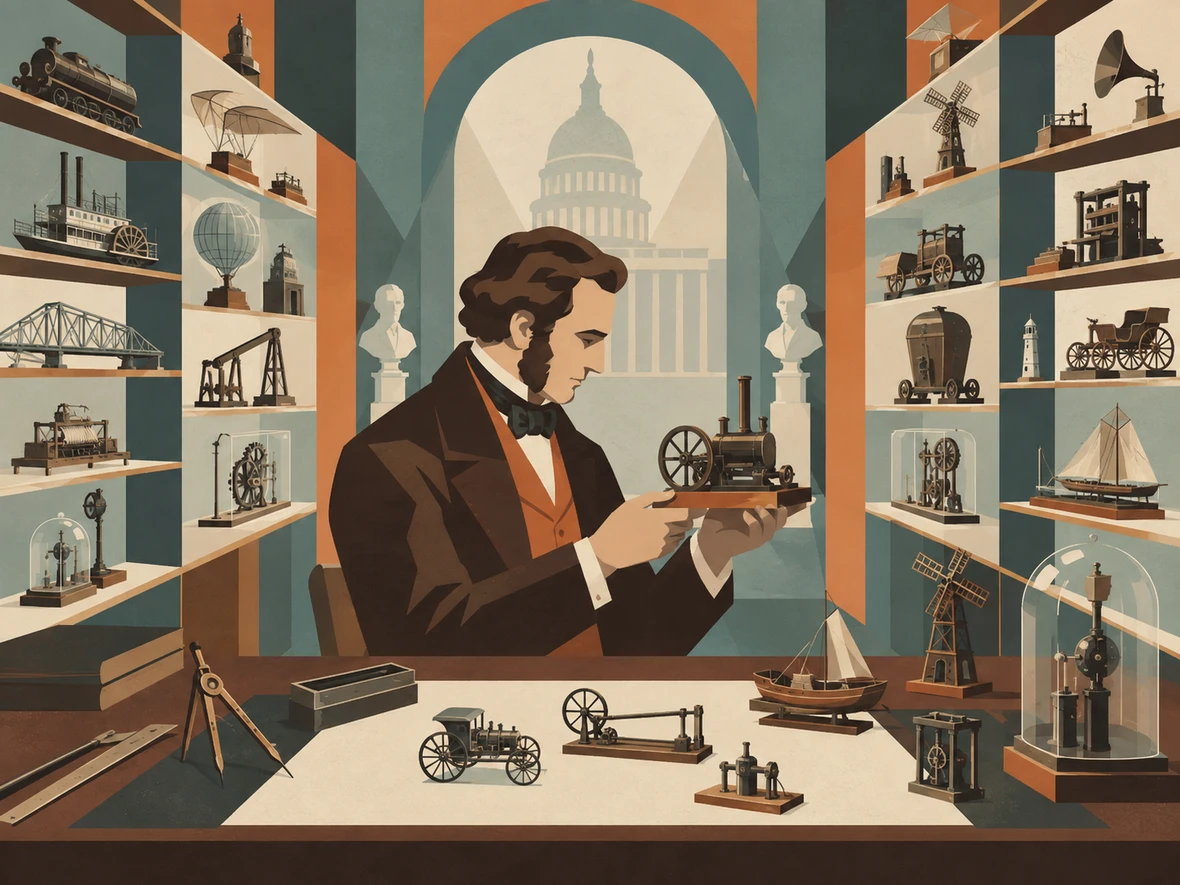
For much of the nineteenth century, applying for a United States patent could involve paperwork, drawings and a small physical object that was supposed to make the paperwork easier to understand. From 1790 until 1880, the Patent Office required models for the majority of applications.1
The model was not a souvenir. It was evidence. Patent examiners had to decide whether a claimed invention was novel and explained clearly enough, and a three-dimensional example could make a mechanical idea easier to compare with earlier ones. The Smithsonian describes the models as tools for explaining proposed innovations and comparing them with similar inventions.2 In an age before searchable image databases, one perfectly reasonable information system was apparently to put the machine on the table.
The arrangement created a second institution almost by accident. The Patent Office was also becoming a museum.
The first great warning arrived on 15 December 1836, when a fire destroyed the Patent Office and much of the material relating to the patents issued before the new numbering system. USPTO historians put the lost pre-1836 patents at nearly ten thousand, including specifications and scale models.3 Congress had already passed the Patent Act of 1836 that year, creating a formal examination system and professional patent examiners. When the first purpose-built Patent Office opened in 1840, rows of patent models became one of its major public attractions.4
That meant an administrative requirement had acquired display cases, tourists and a collection problem.
Abraham Lincoln supplied one of the better-known survivors. His 1849 patent for a method of buoying vessels over shoals came with a working model, partly whittled by Lincoln himself.1 It is memorable because Lincoln later became president. At the Patent Office, however, it was one small object among thousands submitted because the Office wanted to see what applicants said their inventions would do.

The law itself became less absolute before the practice did. The Patent Act of 1870 said that when an invention could be represented by a model, the applicant had to furnish one if required by the Commissioner.5 That sounds like the beginning of discretion because it was. Yet the Office kept asking for models broadly. In his 1873 annual report, the Commissioner argued that experience showed models should be demanded in all cases that could be represented by one, and even recommended changing the law to make that requirement explicit.6
The legal wording had loosened. The institutional habit had not.
Then came the second major fire. On 24 September 1877, fire broke out in the Patent Office building. Contemporary reporting in Scientific American said roughly 87,000 patented models were destroyed, along with tens of thousands of models from postponed and rejected cases.7 This time the active patent records survived, but a very large portion of the physical collection did not. A bureaucracy that had spent decades turning inventions into small objects had discovered one disadvantage of keeping enormous numbers of small objects in the same building.
The pressure to change was now difficult to ignore. In his 1879 annual report, the Commissioner recommended that no model be required unless an examiner certified in writing that it would be useful, or the Commissioner specially ordered one.8 USPTO's own historical summary says models were required for the majority of patent applications from 1790 until 1880.1 After that, models became exceptional rather than routine.
The collection remained. In 1908 the Smithsonian began receiving models from the Patent Office, and in 1926 Congress decided to dispose of the stored collection and allowed the Smithsonian to select what it wanted to preserve. The National Museum of American History says its patent-model holdings now exceed 10,000 objects dating from 1836 to 1910.2
Among them is Lincoln's little model for Patent No. 6469.1