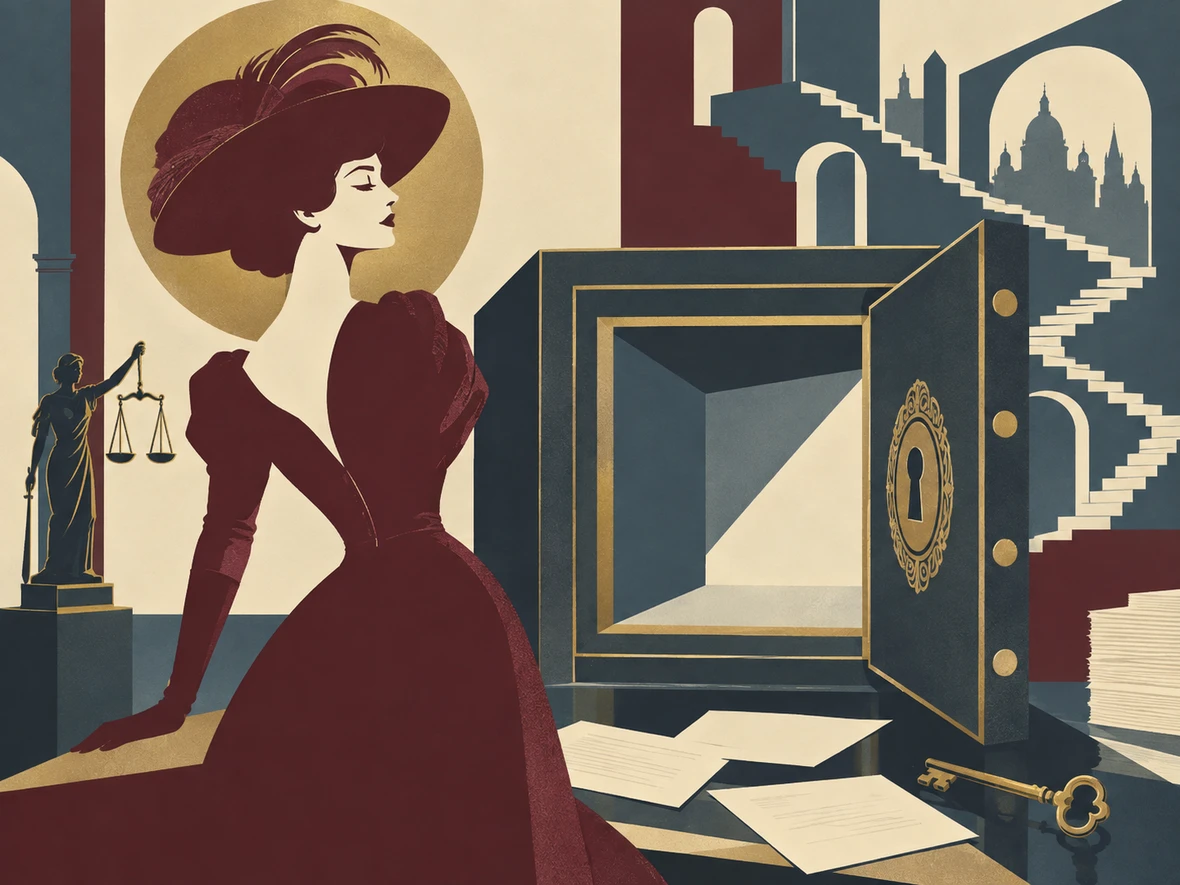
On the morning of 9 May 1902, lawyers, creditors and officials gathered around a safe inside one of the most famous private houses in Paris.1,2
For roughly twenty years, everyone had been told the safe contained securities worth about one hundred million francs.
Not cash.
Bonds and financial paper.
Enough money that banks, financiers, tradespeople and private lenders had advanced Thérèse Humbert enormous sums against it.1
The problem was that the fortune was tied up in a complicated inheritance dispute.
Court orders said the securities had to remain locked away until the litigation was resolved.1
So lenders could not simply say:
“Open the safe.”
The legal system itself was helping explain why the money could not be inspected whenever somebody became suspicious.
Very convenient.
Then, in 1902, a judge finally ordered the safe opened.
Everybody gathered around.
The locks came off.
The door opened.
Contemporary newspapers disagreed almost immediately about what was inside.
A penny.
A button.
An Italian coin.
Old papers.
A brick.
Nothing at all.1
The specific souvenir changes depending on which newspaper you read.
The important part is stable.
There was no fortune.
And Thérèse Humbert was already gone.
Which raises a fairly reasonable question.
How do you borrow millions for twenty years against money that does not exist?
The answer is:
very carefully.
Thérèse was born Marie-Thérèse Daurignac in rural southwestern France in the 1850s, into a family without anything remotely resembling the fortune she would later claim.1,4
She was intelligent, socially ambitious and extremely good at one particular skill:
making a story difficult to challenge without first accepting half of it.
And this was useful because Frédéric came with a very good surname.
His father, Gustave Humbert, was a prominent politician who eventually served as French minister of justice.1
That does not mean Gustave was secretly running Thérèse’s fraud.
Later newspapers accused basically everyone with a recognizable surname of helping her.
Modern scholarship is much more cautious about that.1
What is clear is that Thérèse used her connection to Gustave Humbert constantly.
If a lender became nervous, she could point toward one of the most respectable legal-political families in France and say, essentially:
Do you really think these people would be involved if my money were imaginary?1
That is an excellent argument right up until the money turns out to be imaginary.
The foundation of the scheme was an American millionaire named Robert Henry Crawford.
Crawford did not exist.1
But before anybody knew that, Thérèse told a wonderful story about him.
Actually, she told more than one.
That is worth remembering because the famous version is often repeated as though investigators later confirmed it. They did not. Modern scholarship notes that Humbert gave different origin stories for the relationship.1
The best-known version goes like this.
Young Thérèse is travelling by train in the late 1870s.
She hears a man in distress in another compartment.
The man is Robert Henry Crawford, fabulously wealthy American.
He is suffering a medical emergency.
Thérèse saves him.
Crawford is deeply grateful.1
Later he dies.
And in 1881, the story says, he leaves Thérèse one hundred million francs in securities.1
That is the kind of inheritance that changes how bankers pronounce your name.
There is one problem.
Another will appears.1
This second will benefits Crawford’s two nephews:
Robert Crawford and Henry Crawford.
It also involves Thérèse’s younger sister Marie in a bizarre marriage arrangement. According to the story, Marie is supposed to marry one of the Crawford brothers.1
And there is an even better detail.
The two wills are supposedly dated the same day and signed by the same people.1
At this point, a normal inheritance dispute would become simpler.
Thérèse’s becomes more complicated.
The Humberts and the Crawford nephews negotiate an agreement.
The enormous fortune will remain locked in a safe until the dispute is resolved and until the marriage conditions involving Marie are sorted out. The assets are placed under a form of judicial sequestration: effectively frozen under legal supervision.1
Thérèse cannot spend the hundred million.
The Crawfords cannot take it.
The safe stays locked.
And this is the genius of the fraud.
Because now the absence of money is no longer evidence that Thérèse has no money.
It is evidence that she is obeying the court.1
She can say:
Of course I cannot show you the fortune.
I am legally forbidden to touch it.
But it exists.
The judges know about it.
The lawyers know about it.
Look at all these lawsuits.
And lenders did look.
They saw real court cases.1
Real lawyers.
Real legal documents.
Real rulings.
Real disputes involving people calling themselves Robert and Henry Crawford.
And here is the best part.
The Crawford brothers were not American millionaire nephews.
They were Thérèse’s own brothers, Emile and Romain Daurignac, playing parts in the story.1
This family did not merely invent an inheritance.
They gave the inheritance supporting characters.
Then they sued themselves.
The lawsuits were useful because every delay made the imaginary fortune more credible.
Why would a court spend years litigating over money that did not exist?
Why would respectable lawyers participate?
Why would judges issue orders about the safe?
Why would a former justice minister’s family be anywhere near this?
These are reasonable questions.
And because the fortune was supposedly enormous, lenders were willing to tolerate very high interest rates.
Some contemporary reports describe rates reaching extraordinary levels—sometimes as high as sixty percent.1
From a banker’s perspective, the logic was simple.
If Thérèse eventually gets her hundred million francs, then a huge loan today can return a spectacular profit later.
So lenders keep lending.
Then something else happens.
The people who have already lent her money become invested in keeping the story alive.
If Thérèse loses the inheritance case, they may lose everything.
So when she needs more money to continue the litigation...
they lend more.1
This is not quite a Ponzi scheme in the later technical sense.
It is almost more elegant.
The creditors finance the legal machinery that proves to the creditors that their collateral exists.
And the safe remains closed.
They buy a huge house at 65 Avenue de la Grande Armée in Paris.
Thérèse entertains politicians, officials, bankers and fashionable society.
Contemporary reports credit the family with country properties, an opera box, vineyards and even a steamboat used to move between estates.1
Some of those luxury details are difficult to verify individually because the press became obsessed with her taste after the fraud collapsed.
This appearance matters.
If you lend money to somebody living in a mansion, entertaining ministers and surrounded by lawyers, you feel less like the victim of a scam.
You feel like a banker.
Thérèse also had a talent for turning social connections into collateral.
One lender later testified that he had been suspicious until Gustave Humbert’s position reassured him.
Then he lent millions.1
Others described seeing important public figures around the family and interpreting those relationships as proof that the Humberts must be legitimate.1
This is how a con becomes infrastructure.
Nobody has to personally verify everything.
Everybody verifies somebody else.
The banker trusts the politician.
The politician assumes the lawyer checked.
The lawyer sees the court order.
The court sees documents supplied by the parties.
The lender sees the safe.
And nobody opens the safe.
There is an even stranger problem.
Some bankers and lawyers later claimed they had inspected packages of securities associated with the Humbert fortune. One witness said he had personally counted tens of millions of francs’ worth.1
So after the fraud collapsed, historians and journalists were left with another question.
Were forged securities temporarily placed in the safe to reassure selected lenders?
Did people see bundles and assume the rest?
Did Thérèse remove fake securities before fleeing so she would not leave obvious forgeries behind?
We do not know.1
The safe is not just the ending of the story.
It is one of the mysteries inside it.
And through all of this, Thérèse becomes famous enough to acquire a nickname:
Paris knows her.
Creditors know her.
The press knows her.
Which makes the next phase extremely difficult to hide.
By the beginning of the twentieth century, the arithmetic is becoming impossible.
There are too many loans.
Too much interest.
Too many people asking when the Crawford litigation will finally end.1
Creditors begin pushing harder.
Journalists become more aggressive.
On 9 May 1902, officials go to the Avenue de la Grande Armée.1
A crowd gathers outside.
Inside, lawyers and creditors gather around the safe.
Thérèse and Frédéric are not there.1
They have fled.
Then the safe opens.
No bonds worth a hundred million francs.
No Crawford fortune.
No financial miracle.
Investigators start pulling the structure apart.
There is no Robert Henry Crawford.1
There are no American Crawford nephews.
The nephews are Thérèse’s brothers.1
The wills are forged.1
The inheritance is fictional.
And by contemporary estimates, loans running from tens of millions into the hundreds of millions of francs had been extended against it. The exact total is impossible to state cleanly because newspapers used different methods and frequently sensationalized the number. Matt Smith’s modern study therefore treats the estimates as a range rather than pretending one perfect total survives.1
The scandal is enormous.
And it spreads in directions you would never expect.
For example:
Henri Matisse.6
At this point Matisse is not yet Matisse in the way museums mean it now.
He is an ambitious, financially insecure painter married to Amélie Parayre.
Amélie’s parents worked inside the Humbert household. Her mother was the family’s housekeeper.6
When Thérèse disappears, the Parayres become obvious people for investigators and furious creditors to question.
Matisse’s father-in-law is arrested.
His studio is searched.
The family is harassed by angry victims.
Matisse ends up trying to defend his in-laws while supporting an enlarged household financially.6
His biographer Hilary Spurling argues that this episode helps explain the darker, more commercially cautious period in Matisse’s work around 1902–03.6
So a fake American millionaire indirectly interferes with the development of modern French painting.
That is a very efficient fictional character.
Meanwhile, the actual Humbert family is missing.
Police search across Europe.
For months they fail to find them.1
Then, in late 1902, the family is discovered hiding in Madrid.1
They are arrested and eventually returned to France for trial.
And if you think Thérèse’s strategy at trial is:
“perhaps now is the time for quiet remorse,”
no.

One contemporary American newspaper describes crowds straining to see the defendants enter.
Thérèse repeatedly interrupts proceedings.5
When asked where she lives, she answers:
“In prison.”5
And Thérèse behaves less like somebody whose imaginary American relatives have just been exposed than somebody mildly irritated that everyone else has misunderstood the plot.
When her husband Frédéric is questioned about where the Crawford millions are, he says he knows nothing about them.
Thérèse immediately interjects that she does.5
This is after the safe has been opened.
After the brothers have been exposed.
After Madrid.
She is still maintaining the central fiction.
You almost have to admire the commitment to continuity.
The trial lasts from 8 to 22 August 1903.3
Thérèse and Frédéric are convicted of fraud and forgery-related offenses and sentenced to five years in prison.1,3
Her brothers receive shorter sentences—three years for one, two for the other.1
The punishments strike some contemporary observers as surprisingly light given the scale of the affair.
The Musée du Barreau de Paris points out one awkward reason the French legal world may not have wanted to push the moral outrage too theatrically:
lawyers and institutions had helped make Thérèse believable.2
The fraud did not last twenty years because one woman hypnotized France.
It lasted because respectable systems kept authenticating pieces of it.
Courts issued rulings.
Lawyers litigated.
Banks lent.
Politicians socialized.
Creditors refinanced.
Everybody had paperwork.
The paperwork referred to more paperwork.
And somewhere inside the whole machine was an empty safe.
Thérèse was eventually released before serving every day of the nominal five-year sentence, after time already spent in custody and later clemency measures.1
Then her trail becomes surprisingly vague.
You will find confident claims that she moved to the United States and died in Chicago in 1918.
Other sources give different endings.
The documentary record is much weaker here than it is for the fraud itself.
So I’m not going to give her a tidy final scene just because biographies like tidy final scenes.
Her disappearance from public life is almost appropriate.
The woman who spent twenty years constructing Robert Henry Crawford eventually becomes difficult to reconstruct herself.
But the safe is enough.
Because the cleverest part of Thérèse Humbert’s fraud was not inventing a rich man.
People invent rich relatives constantly.
The clever part was building a world in which not seeing the money became evidence that the money was real.
Why can’t we inspect it?
Court order.
Why is the case taking so long?
Complicated inheritance.
Why are there so many lawsuits?
Because the fortune is enormous.
Why do respectable people trust her?
Because other respectable people trust her.
Why are the Crawford brothers so difficult to find?
America is very far away.
And then, after twenty years, somebody finally does the one thing the entire structure has been designed to postpone.
They open the box.