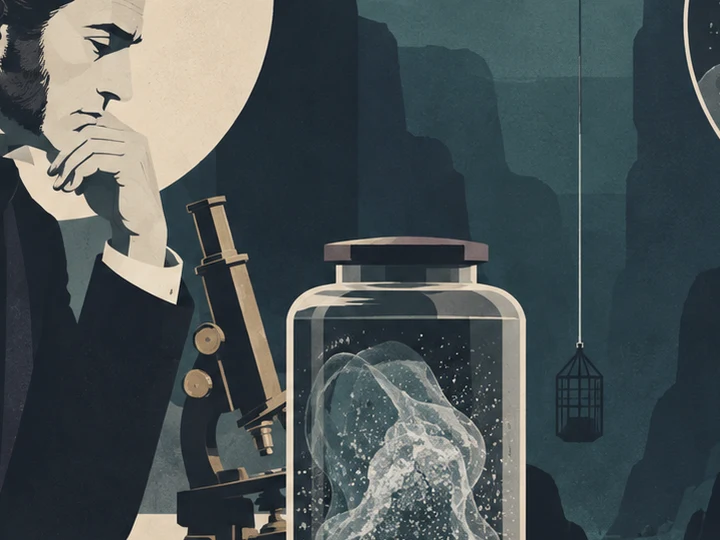
In 1904, American physicist Robert Wood walked into a laboratory in Nancy, France, watched a group of scientists demonstrate a new form of radiation...
and quietly removed part of the experiment while they were using it.
They kept seeing the radiation.
Which is awkward.
This story normally gets told as:
French scientist invents imaginary rays.
American scientist does prank.
French scientist looks stupid.
The end.
And that version misses almost everything worth knowing.
The French scientist was Prosper-René Blondlot.
And Blondlot was not stupid.
He was fifty-three when the whole thing started, a professor of physics at the University of Nancy and a respected experimental physicist. He had worked seriously on electromagnetism, electrical propagation and the measurement of electromagnetic-wave speeds. He had been elected a corresponding member of the French Academy of Sciences in 1894 and had already received major scientific prizes before anyone had heard of an N-ray.1,5,6
So if you were a physicist in 1903 and René Blondlot told you he had detected something strange in the laboratory, laughing at him would not have been the intelligent first response.
Especially in 1903.
Physics had spent the previous decade behaving very badly toward anyone who thought the basic inventory of nature was probably complete.
X-rays had appeared in 1895.
Radioactivity in 1896.
The electron in 1897.
Invisible radiation and previously unknown particles were not fringe ideas.
Blondlot was studying X-rays and trying to understand how they behaved when he began noticing something else.

That sounds like a manageable observation until you get to the words:
“appear brighter.”
Because the effect was tiny.
Really tiny.
The experiments were performed in darkened rooms, with observers staring at weak sparks or dim phosphorescent surfaces and deciding whether they looked slightly more luminous under one condition than another.1,2,3
And human vision near the threshold of visibility is an extremely cooperative instrument.
If you expect to see something, your brain is very happy to help.
Blondlot did not know that was the problem.
He thought he had found a new radiation capable of passing through materials that stopped ordinary light.
He named it the N-ray.
A new ray discovered at the University of Nancy.
Very tasteful.
And then the discovery started growing.
Other researchers in France reported N-rays too.
They found supposed new sources.
New effects.
New varieties.
The rays were associated with heated metals and certain physical materials. Researchers claimed that the human body emitted them. Augustin Charpentier, a physiologist at Nancy, reported effects associated with nerves and muscles and pushed the idea into physiology.1,2
Soon N-rays were not just one weird observation by Blondlot.
They were a research field.
Historian of physics Robert Lagemann counted roughly 120 trained scientists publishing almost 300 papers on N-rays between 1903 and 1906.2
That number is worth sitting with for a second.
Not three cranks in a basement.
About 120 scientists.
Almost 300 papers.
And all of them are studying something that isn’t there.2
The field even developed disputes.
Priority claims.
Arguments about properties.
Different laboratories reporting slightly different forms of the phenomenon.1
Which is very normal science behavior.
Except for the slight issue that the central object of study does not exist.
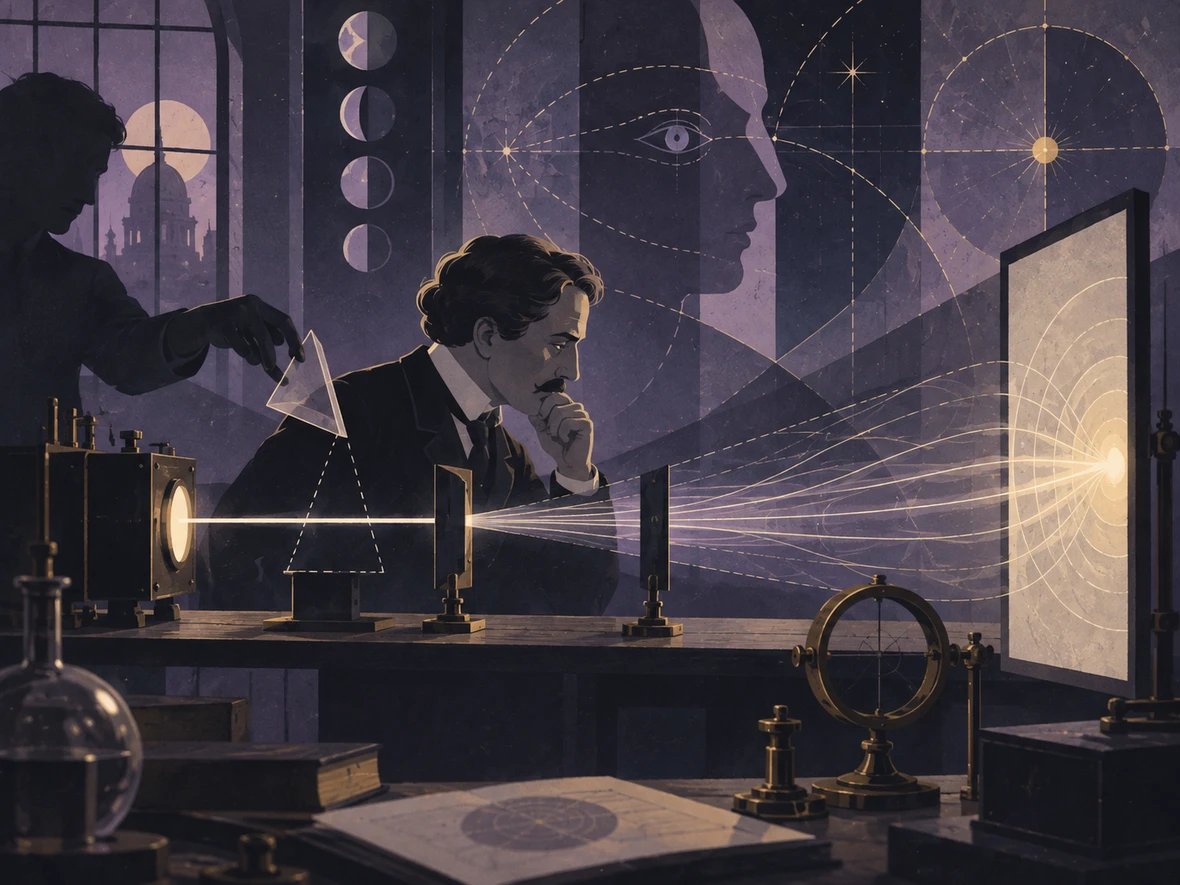
Blondlot also developed a way of producing an N-ray spectrum.
The idea was that a beam of N-rays could pass through a narrow opening and an aluminium prism, which would refract different components by different amounts. A faint phosphorescent detector could then be moved through the expected positions of the lines.1,3
And the observers found them.
Specific bright points.
Measurable spectral lines.
Numbers could be written down.
Tables could be made.
Once a phenomenon has a table, it feels much harder to argue with.
There were skeptics, though.
Researchers in Britain, Germany and elsewhere repeatedly failed to reproduce the effects. Some physicists spent hours in dark rooms staring at the apparatus and saw absolutely nothing.1,3
And this quickly took on a slightly national flavor.
A cluster of French experimenters could see N-rays.
Many foreign laboratories could not.
That is not the sort of situation early twentieth-century European science was famous for handling without ego.
Blondlot and his supporters answered that the effects were subtle and that some observers simply lacked the required visual sensitivity.3
Which is a dangerous defense.
Because once the explanation for failed replication becomes “perhaps you are physically incapable of seeing how correct I am,” the experiment has started building itself a small emergency exit.
Then Robert W. Wood gets involved.
Wood was an American physicist at Johns Hopkins University and one of the great experimental troublemakers of his generation.
He was a serious optics researcher—spectroscopy, ultraviolet and infrared work, diffraction gratings, photography—but he also had a strong instinct for experiments that asked extremely rude questions of other experiments.3,7
In 1904, after failing to see convincing evidence of N-rays himself, Wood travelled to Nancy to watch Blondlot’s demonstrations.3,4
The laboratory had to be extremely dark.
This is important.
Not cinema dark where you can still see your drink.
Dark enough that the supposed N-ray effect on a weak spark or phosphorescent screen sat right at the edge of perception.3,4
Blondlot and his assistant began demonstrating the effect.
Wood could not see it.
They could.
This was explained as a problem with Wood’s eyes.3
Fair enough.
Different observers can have different sensitivity.
So they moved on to the N-ray spectrum.
The aluminium prism was put into position.
The room was darkened.
Nobody noticed.
More importantly:
the spectral lines did not disappear.
The instrument had been physically changed so that the claimed optical arrangement could not be operating as described.
The observations continued anyway.
Wood tried variations of the same basic idea with other demonstrations.
If the observer did not know whether the physical conditions had been changed, the reported N-ray effect did not reliably follow the apparatus.3,4
And that is the moment the whole story becomes much more interesting than “ha ha, no prism.”
Because Wood had not discovered that Blondlot was lying.
If Blondlot had been deliberately faking the result, removing the prism would have been easy to deal with.
You just stop reporting the lines because you know they’re fake.
Instead, Blondlot kept seeing them.
Wood spent about three hours watching the demonstrations and left Nancy convinced that the positive observers had, as he put it, somehow been deluded.3
On 29 September 1904, Nature published his report, “The N-Rays.”3
It is only about two pages long.
Which is mildly unfair considering how much scientific literature it helped ruin.
Wood described the demonstrations, his inability to perceive the effects and the covert changes to the apparatus.3
And then the N-ray field began collapsing.
Not instantly.
This is another place where the legend gets too clean.
There was no meeting where everyone stood up, looked at Wood’s pocket, and formally voted the rays out of physics.
Some supporters defended the work.
Blondlot certainly did.
But the combination of failed replication abroad and Wood’s controlled interference with the apparatus made the central problem increasingly impossible to ignore. Within months, confidence in N-rays had largely evaporated outside the remaining group around Nancy.1,3,4
The timing was particularly painful for Blondlot because the French Academy of Sciences awarded him the Prix Leconte in 1904.1,5
You will sometimes see that described as “the Academy gave him a huge prize for discovering N-rays.”
Not quite.
The award recognized Blondlot’s scientific work more broadly, and the Academy’s justification leaned on his established research rather than simply announcing N-rays as proven fact.1,5
That nuance matters because Blondlot had actually done good physics.
The N-ray affair did not retroactively make every experiment of his career imaginary.
But it did attach itself to his name permanently.
And then people made the story even crueler afterward.
A popular later version claims Wood’s exposure destroyed Blondlot mentally—that he went insane from humiliation and died shortly afterward.1,4
That is false.
Blondlot continued teaching in Nancy, remained connected with the university and lived until 1930.
He also appears to have continued believing in N-rays long after most physicists had abandoned them.1,4
Which is a much more uncomfortable ending.
Because if Blondlot had been exposed as a fraud, the story would be easy.
Bad scientist lies.
Good scientist catches him.
Science wins.
Everybody goes home.
And Blondlot was not self-deceiving alone.
Remember:
120 scientists.
Almost 300 papers.2
How does that happen?
Partly because the measurement was subjective.
The experimenter knew when the N-ray source was supposed to be active.
The observer often knew what result was expected.
The claimed effect was a tiny change in brightness seen in near-darkness.
And then successful observations started teaching new observers what success was supposed to look like.
You stare at the dim screen.
The experienced person says the brightness has increased.
You look harder.
Maybe it has.
Next trial.
There.
That one definitely looked brighter.
Now you are getting good at seeing N-rays.
And once papers begin appearing, the psychological pressure changes again.
You are no longer asking:
“Does this exist?”
You are asking:
“What properties does this newly discovered thing have?”
That is a completely different mental posture.
The first question is still open.
The second quietly assumes the answer.
Wood’s trick with the prism mattered because it forced those two questions back together.
If the spectrum remains visible after the prism has been removed, you do not need a sophisticated new theory of N-ray optics.
You need to reconsider whether there is a spectrum.
There is also a funny national twist to the aftermath.
The name “N-ray” was chosen as a tribute to Nancy.
The city ended up lending its initial to one of the most famous nonexistent objects in the history of experimental physics.
Not ideal branding.
But I don’t think Blondlot deserves to be remembered as an idiot.
Honestly, that interpretation lets the rest of us off too easily.
If only stupid people could fool themselves, there would be very little reason to teach this story in science classes.
The interesting part is that Blondlot was competent.
His colleagues were trained.
Their papers looked scientific.
They had instruments.
They had measurements.
They had replication.
They had a growing specialist literature.
What they did not have was a reliable way of stopping the observer’s expectation from leaking into the observation.1,2,4
And Robert Wood’s most important contribution was not that he was clever enough to steal a prism in the dark.
It was that he asked a brutally simple experimental question:
If I change the thing you say causes the effect...
without telling you...
does the effect change too?
It didn’t.
That is a very small experiment.
It killed an entire radiation.