In 1793, Kew Gardens received three baskets of plants from Penang.
The receiving ledger supplied the important botanical conclusion.
They were dead.1
That happened often enough to be ordinary.
European collectors could gather living plants on the other side of the world, pack them onto a ship, wait several months and discover that salt spray, darkness, bad watering, temperature changes, rodents or simple neglect had converted an expensive botanical expedition into compost.1
Seeds travelled better. Dried specimens travelled beautifully. Living plants had opinions.
Then a London doctor became interested in a moth cocoon.
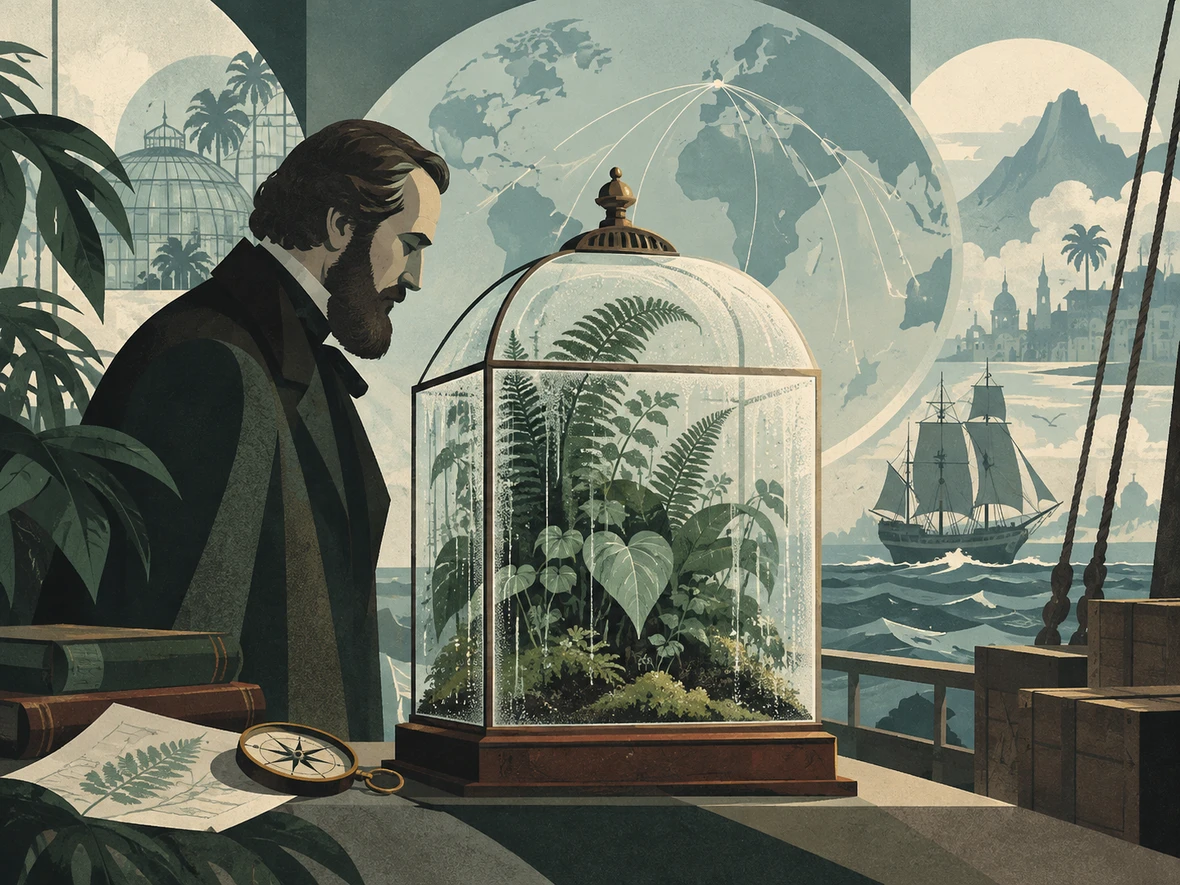
Nathaniel Bagshaw Ward was a physician and enthusiastic amateur naturalist. In 1829 he placed a moth chrysalis in a covered glass container with damp soil. The moth project did not become the important part. A fern and grass began growing inside the sealed environment instead.1,2
Ward noticed that the moisture remained in circulation. Water evaporated, condensed against the glass and returned to the soil. Light entered. Sooty London air stayed largely outside.
A tiny environment had accidentally become more reliable than the city surrounding it.
Ward kept experimenting.
By the early 1830s he had developed glazed cases large enough to hold living plants for transport. In 1842 he published On the Growth of Plants in Closely Glazed Cases, a short book explaining the conditions under which plants could survive inside sealed or nearly sealed containers and devoting an entire section to carrying plants and seeds aboard ships.3
The object that took his name was not complicated in appearance.
It was basically a wooden frame with glass panels, soil and plants inside.
The cleverness lay in what the box excluded and what it recycled.
A Wardian case could sit on deck where plants received sunlight while the glazing protected them from salt spray and much of the drying wind. Moisture stayed inside rather than requiring a sailor to remember that the rare fern from another hemisphere had a watering schedule. Later designs added battens to brace plants and protect the glass, feet to lift the box from wet decks and screened ventilation openings to keep animals out.1,2

In other words, the breakthrough in global botany was partly a box that reduced the number of opportunities for a ship to kill the cargo.
Ward wanted proof.
In 1833 two cases containing ferns, mosses and grasses were sent from London to Sydney. The plants survived the voyage. Australian plants were then packed into the cases for the return journey and also arrived alive. Kew and other botanical institutions rapidly understood what this meant.2,3
A ship had become more than a one-way plant funeral.
The Wardian case changed the economics of living collections because survival rates mattered more than the romance of collecting. A botanist could find a plant that had never been cultivated in Britain, but scientific value and commercial value both approached zero if the specimen reached the destination as a brown stain.
The glass case made survival reproducible enough to build systems around it.
Kew began using Wardian cases during the 1840s. Joseph Dalton Hooker sent plants from New Zealand in a large case during the Antarctic expedition of 1839–1843. By 1847 Kew was using a standard shipping case that could hold around twenty-eight plants.1
The object moved quickly from experiment to infrastructure.
That transition matters because the Wardian case is often remembered as a charming ancestor of the terrarium.
It was that.
It was also involved in rearranging the commercial geography of the nineteenth century.
Britain's botanical institutions were already collecting plants globally. Kew functioned as a scientific garden, archive, exchange hub and increasingly an imperial institution whose expertise could help determine which species might be cultivated in which colonies. A technology that kept live plants alive at sea did more than enrich greenhouse collections. It made plantation projects easier to attempt.1,5
Tea is the famous example.
Britain consumed enormous quantities of Chinese tea and wanted commercial production under British control. Tea already grew in Assam, and British experiments there predated the Wardian case's major use in the trade. The technology therefore did not single-handedly create Indian tea, despite the way simplified invention stories sometimes imply it did.4
What the case did was make one particularly audacious botanical transfer far more practical.
In the late 1840s, the East India Company sent Scottish botanist Robert Fortune into China to obtain tea plants, seeds and cultivation knowledge. Fortune's first shipments suffered the old problem: plants died. He then used Wardian cases to carry large quantities of living tea material toward India. Kew's history of the tea trade describes roughly 20,000 plants being dispatched on several ships during the enterprise.4
The cases did not teach anyone how to grow tea.
Chinese growers did.
Fortune also recruited skilled Chinese tea workers and obtained tools and knowledge about processing. That human expertise mattered as much as the transported plants, and Assam's indigenous tea varieties ultimately became more commercially important than the simplistic story of Britain stealing one Chinese plant and inventing an industry.4
The Wardian case's role is still substantial.
It made living plant material portable enough to participate in industrial strategy.
The same pattern appeared with cinchona.
Cinchona trees from the Andes supplied bark containing quinine, one of the major treatments for malaria. European empires wanted dependable access to the plant and tried to establish plantations in Asia. British and Dutch projects moved cinchona material out of South America and attempted cultivation in India and Java. Wardian cases were part of that movement, though modern scholarship emphasizes how difficult the transplanting remained: the box improved transport; it did not make ecology obedient.5,6
Plants could survive an ocean and still dislike the destination.
Rubber followed another route through this botanical transport system.
In the 1870s, rubber seeds from Brazil were taken to Kew, germinated and then shipped as seedlings toward Ceylon and Southeast Asia. Wardian cases helped protect live material during sections of the transfer. The resulting plantation economies eventually shifted the global rubber industry away from its South American center.1,5
Again, the case did not accomplish this by itself.
Governments, botanic gardens, collectors, local labor, plantation capital, coercive colonial systems and environmental conditions all mattered. The box was an enabling technology inside that machinery.
That is more historically interesting than calling it a miracle greenhouse.
Small infrastructure often disappears inside the industries it makes possible.
A railway gets monuments. A glass shipping crate becomes background.
The Wardian case deserves attention precisely because it was background. Once standardized, it could be packed, loaded, listed in an archive and treated as a normal piece of botanical equipment. Kew correspondence from the nineteenth century discusses cases almost casually: which plants were inside, how the soil was arranged, whether the drainage plug had been opened, where the shipment was going.1
The revolutionary technology had become a container.
It also altered domestic life.
Closely glazed cases became popular in Victorian homes for growing ferns and other moisture-loving plants, especially in polluted cities where delicate species struggled outdoors. Ward's original London observation therefore looped back into urban horticulture: the same principle that protected a plant from an ocean voyage could protect it from coal smoke outside the window.2,3
There is a pleasing scale problem here.
The object was small enough to stand in a drawing room.
Its consequences were large enough to appear in histories of empire, medicine, agriculture, environmental change and global trade.
That combination also created ecological consequences nobody in 1829 could fully map.
Moving living plants more reliably meant moving species beyond their established ranges. Some transfers became profitable crops. Some became ornamentals. Some contributed to invasive-species problems and new plant diseases. Luke Keogh's modern history of the Wardian case treats it as a technology that helped reorganize global plant communities as much as botanical collections.5
The case therefore belongs to the history of transport even though it never moved under its own power.
Ships already crossed oceans.
What changed was the kind of passenger likely to survive them.
Before Ward, the voyage itself acted as a harsh filter. A living plant had to survive salt, darkness, inconsistent care and months of exposure. The case replaced some of that uncertainty with a controlled microenvironment.
It was a portable piece of climate.
That phrase is more literal than it sounds.
Inside the glass, water cycled locally. The soil retained moisture. Light crossed the boundary while much of the external atmosphere did not. The plant occupied a small engineered environment nested inside a much larger hostile one.3
Modern shipping containers standardize dimensions so cargo can move between trucks, trains and ships.
The Wardian case standardized survival, which made plant exchange scalable. Kew used the cases for more than a century. The Gardens' last recorded Wardian-case shipment arrived from Fiji in 1962, by which point air travel and modern quarantine systems had changed plant transportation again.1,2 The long lifespan is a good measure of the design: an accidental fern in 1829 had produced a piece of equipment still being used when humans were preparing to go to the Moon.
Glass, wood, soil and a plant were enough to make the object look almost embarrassingly simple. The real invention was making those ordinary materials behave as a dependable environment for months at sea.
That is why the history of the Wardian case is not really about a box. It is about what happens when something fragile becomes transportable: scientific collections expand, nurseries gain new species, plantation economies relocate, medicines acquire new supply chains, and landscapes change. Somewhere near the beginning of that chain is a London doctor looking into a glass container because the moth he had put there was no longer the most interesting thing inside it.