British coins can be called before a court.
Not metaphorically. The Trial of the Pyx has a jury, a presiding judicial officer, evidence, statutory standards and a verdict. Its defendant is the previous year’s coinage, represented by samples removed from production at the Royal Mint.1
The arrangement is old enough that even its origin comes with several dates. The Goldsmiths’ Company records a public trial in 1248, when twelve London citizens and twelve goldsmiths were selected to examine the money.1 In 1279, Edward I issued an ordinance describing how a sample of the Mint’s daily work should be placed in a box for later testing.2 The Royal Mint Museum describes independent checking under the Trial of the Pyx as established by at least 1282.3
The box supplied the name. “Pyx” comes from pyxis, a small box or chest. Coins set aside for trial were kept in such containers so the Mint’s output could later be checked by people outside the Mint itself.1
That independence mattered because coinage was a promise expressed in metal. A coin was supposed to have the weight and composition the law said it had. Medieval minting also involved valuable gold and silver, which created an obvious incentive to be extremely precise about whose metal had gone where.
The consequences were once personal. Royal Mint history records that in 1318 a Master of the Mint received six weeks in prison after poor trial results.2 A quality-control meeting has a slightly different atmosphere when the person responsible for quality can leave without his liberty.
The institutional machinery changed over time. In 1580 Elizabeth I gave the Goldsmiths’ Company full responsibility for the Trial, so the jury thereafter came from the Company.1 The Coinage Act 1870 established Goldsmiths’ Hall as the permanent venue, with the first Trial there under that arrangement held in 1871.1,2 The current proceeding remains a formal court and an independent check on the Mint, but it is not a thirteenth-century procedure preserved unchanged under glass.

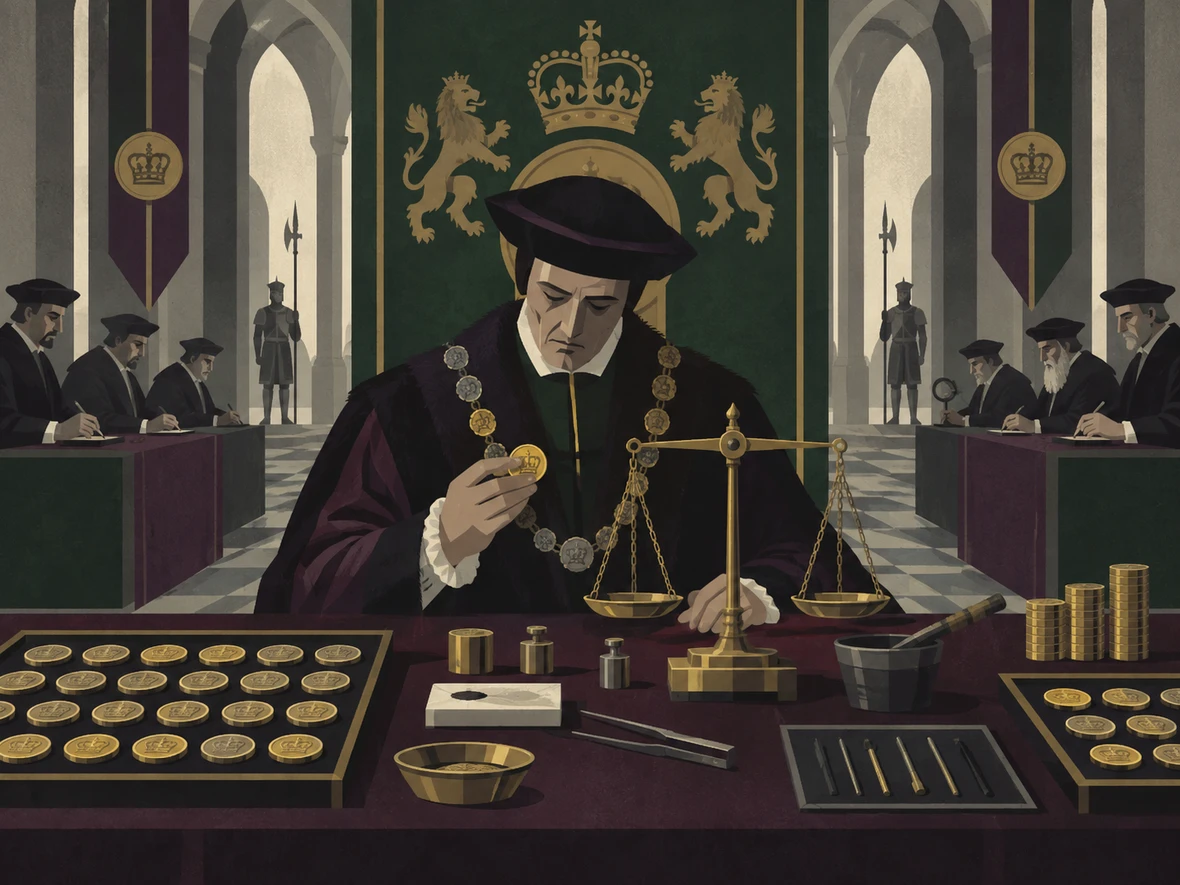
Today, coins are sampled from production and secured in pyx chests for the annual Trial. Jurors check the submitted coins, weigh them and choose samples for more detailed examination. The Goldsmiths’ Company Assay Office then tests selected coins for characteristics including metallic composition; weight and diameter are also checked against the standards and tolerances required by law.3,5
The sequence separates the Mint from the body that checks it. The Royal Mint makes the coins; another body tests whether they meet the required standard, and the jury returns a verdict. That arrangement is more administratively interesting than letting the manufacturer announce that everything appears excellent from inside the factory.
The verdict does not arrive immediately. After the opening proceedings, the court adjourns while the Assay Office completes its work. It reconvenes later, and the result is formally delivered in the presence of the King’s Remembrancer and representatives of the Mint and government.3
The old apparatus has accumulated some equally old objects. Trial plates used as reference standards survive from 1477, while the pyx chests, bowls, robes and courtroom language keep the proceeding visibly ceremonial even as the measurements themselves are modern.1,5
Goldsmiths’ Hall had served as the Trial’s established home since 1871. In 2026, the building was under renovation. The Trial and its later verdict moved temporarily to Mansion House.4